
Last updated: September 2026.
Zero-click search is no longer a minority behavior. New data from SparkToro, built on Similarweb’s clickstream panel, shows that 68.01% of Google searches in the US ended without a click in the first four months of 2026, up from 60.45% in 2024 and roughly 45% in 2016. That trend line is why so many SEO teams are panicking about traffic. But the same research shows what actually keeps winning inside that shrinking click pool: strong brands, task-completing pages, and content that gets cited even when it isn’t clicked. Backlinks sit at the center of all three.
Quick Takeaways
- 68.01% of US Google searches ended without a click in early 2026, a 7.56 percentage point jump from 2024, according to SparkToro’s analysis of Similarweb data.
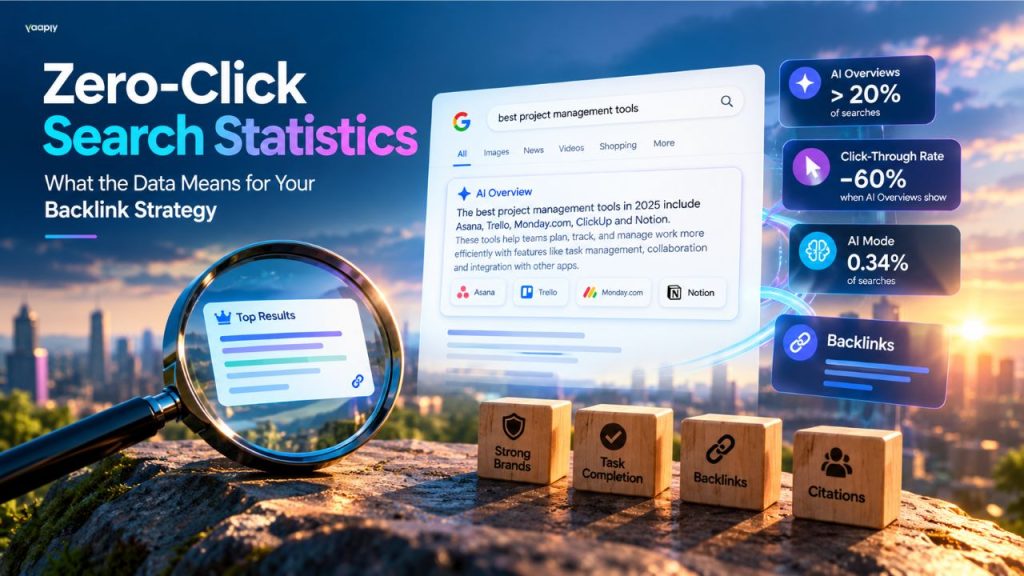
- AI Overviews appear on more than 20% of searches and cut click-through rates by close to 60% when they show, but direct AI Mode use is still small, at 0.34% of searches in the same study period.
- Sites with a recognizable brand won at roughly twice the rate of everyone else, and pages that let a user complete a task outright (not just read information) won 84% of the time versus 50% for pages that didn’t.
- Sites with four or five of these winning traits together won 68 to 70% of competitive searches, meaning the advantage compounds instead of adding up one feature at a time.
- None of this points away from backlinks. It points toward them, because the same signals that build a “recognizable brand” and get a page cited without a click are the ones editorial links have always built.
What Is Zero-Click Search?
Zero-click search happens when someone runs a search and gets their answer directly on the results page, in a featured snippet, an AI Overview, a knowledge panel, or a direct answer box, without ever visiting a website. The person’s question gets resolved. The website that supplied the answer often gets nothing: no visit, no session, no conversion opportunity.
This isn’t new. Featured snippets and knowledge panels have been pulling clicks off the page for years. What changed in 2026 is the scale, driven almost entirely by AI Overviews appearing on a larger share of queries and answering more of them fully enough that a click stops feeling necessary.
The 2026 Zero-Click Search Statistics
Here’s what the current data actually shows, and where it comes from.
The headline number: 68.01%. SparkToro’s research, built on Similarweb’s desktop and mobile web clickstream panel, found that 68.01% of US Google searches from January through April 2026 ended without a click. That’s up from 60.45% in 2024, a jump of 7.56 percentage points in two years, and up from roughly 45% a decade ago in 2016.
AI Overviews are the accelerant, not the whole story. AI Overviews now appear on more than 20% of searches, and when they show, click-through rates drop by close to 60%. But direct usage of Google’s separate AI Mode interface was still small in the study period, at 0.34% of searches. The bigger shift isn’t people switching to a new AI search product. It’s Google answering more of the existing query volume directly on the results page.
Branded search is the exception, not a footnote. Roughly 44% of Google searches are branded, meaning someone is already searching for a specific company or product by name. Those searches still convert to clicks reliably, because the person already knows what they want and Google has less incentive (and less ability) to answer the query for them.
A worth-noting limitation. SparkToro’s data excludes Google’s mobile search app, where zero-click features are reportedly even more aggressive than on mobile web or desktop. The real zero-click rate across all of Google’s surfaces may be higher than 68%.
Why This Is Happening
Google isn’t removing clicks to be difficult. It’s answering more queries directly because it now has the AI infrastructure to do so cheaply and because a large share of queries (definitions, quick facts, simple comparisons) never needed a full page visit in the first place. The queries most exposed to this shift are informational ones: “what is,” “how many,” “when did,” the kind of question that has one correct short answer.
The queries least exposed are the ones tied to a specific brand, a specific task, or a specific transaction. That distinction is the entire strategic story in this data.
What Still Wins in a Zero-Click Environment
SparkToro’s competitive analysis looked at what separates the sites still winning clicks (and citations) from the ones losing them, and the pattern is consistent.
Brand recognition roughly doubles your odds. Sites with strong, recognizable brands won at about twice the rate of unbranded competitors. A person or an AI system is more likely to click through to, or cite, a name it already trusts.
Task completion beats information delivery. Pages that let someone actually finish something, book, calculate, purchase, resolve a problem, won 84% of the time. Pages that just delivered information won only 50% of the time. Being the site that answers a question isn’t enough anymore. Being the site that finishes the job is what gets rewarded.
The advantages compound. Sites combining several of these traits together (a real product or service, a proprietary asset, a niche focus, a recognizable brand, and task completion) won 68 to 70% of competitive searches. No single tactic carries the outcome. The combination does.
| Zero-Click Era Trait | Effect on Click/Citation Rate |
| Recognizable brand | Roughly 2x win rate vs. unbranded competitors |
| Task-completing page | 84% win rate vs. 50% for informational-only pages |
| Four to five combined winning traits | 68 to 70% win rate in competitive searches |
| Branded search query | Reliable click-through, largely unaffected by AI Overviews |
What the Data Means for Your Backlink Strategy
This is the part most zero-click coverage skips, because most of it is written to sell more on-page tactics: better snippets, tighter schema, sharper headlines. Those things still matter. But none of them explain how a page becomes a “recognizable brand” in the first place, or how an AI system decides which source to trust enough to cite without sending a click.
That trust doesn’t get built on-page. It gets built by other credible sites vouching for you, which is what a backlink has always been. When SparkToro’s own follow-up research states plainly that content’s new job is becoming “the source machines cite” rather than the page a person visits, it’s describing exactly what editorial link building produces: a signal, repeated across independent, credible sites, that tells both search engines and AI systems your business is a real, trustworthy authority on the topic.
The mechanism is the same one that’s always separated a real authority from a page that merely ranks. A single site can write anything about itself. An AI system deciding what to cite in a zero-click answer is doing the same cross-referencing a careful researcher would: checking whether other trusted sources back up the claim. That’s a “neighborhood of trust” argument, and it’s the reason a backlink built on a relevant, credible site still does something an on-page tweak cannot: it tells a third party, not just your own website, that you’re worth citing.
Three practical shifts follow from that:
Stop measuring backlinks purely by referral traffic. A link on a relevant, authoritative site that never sends a single click can still be doing its job, building the citation signal that gets you named in an AI Overview or an AI answer for a query you’d otherwise lose entirely to zero-click.
Prioritize links from sites in your actual topical neighborhood. A mention from a site Google and AI systems already treat as credible in your space carries more weight toward “recognizable brand” status than a high-authority link from an unrelated niche.
Keep facts consistent across every site that mentions you. An AI system cross-checking a claim about your business compares what it finds across sources. Inconsistent details across your own site, guest posts, and directory listings undercut the exact trust signal you’re trying to build.
Frequently Asked Questions
What percentage of searches are zero-clicks in 2026?
68.01% of US Google searches ended without a click in the first four months of 2026, according to SparkToro’s analysis of Similarweb clickstream data, up from 60.45% in 2024.
Are zero-click searches caused by AI Overviews?
AI Overviews are a major driver. They appear on more than 20% of searches and cut click-through rates by close to 60% when shown, but they aren’t the only cause. Featured snippets, knowledge panels, and direct answer boxes have been reducing clicks for years; AI Overviews accelerated an existing trend rather than starting a new one.
Does zero-click search mean SEO doesn’t matter anymore?
No, but it changes what SEO needs to accomplish. Ranking for a click is only half the goal now. The other half is being the source an AI system trusts enough to cite even when it doesn’t send a click, which depends more on brand authority and third-party corroboration than on-page optimization alone.
Do backlinks still help if fewer people are clicking through?
Yes, and arguably more than before. A backlink’s value was never only the referral click. It’s a signal to search engines and AI systems that other credible sources vouch for you, which is precisely the “recognizable brand” and trust signal that determines who gets cited in a zero-click answer.
What should I actually change first if zero-click search is hurting my traffic?
Start by auditing which of your pages let a user complete a task versus just reading information, since task-completing pages won 84% of the time in the 2026 data versus 50% for informational-only pages. Then look at your backlink profile: are you building links from genuinely relevant, credible sites, or just chasing volume?
The businesses still winning in a zero-click search world are the ones other credible sites vouch for. That’s what editorial backlinks do, and it’s what we build for a living. If you want to know where your site’s authority signals currently stand, Yaaply can take a look.