
Last updated: September 2026.
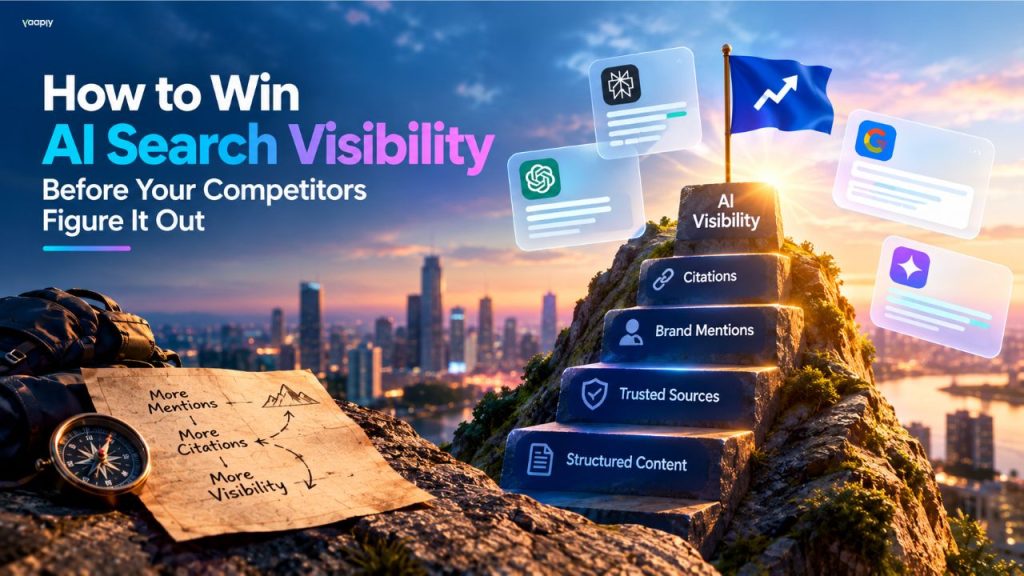
AI search visibility is how often, and how accurately, your brand gets mentioned or cited in the answers AI systems generate, on platforms like ChatGPT, Perplexity, Google AI Overviews, and Gemini. It’s a different measurement than a ranking position, because there’s no page one to rank on. Either the AI names you when it answers a relevant question, or it doesn’t.
Quick Takeaways
- AI search visibility measures presence inside AI-generated answers, not position on a results page. A brand can rank first for a keyword and still never get mentioned by ChatGPT for the same topic.
- What drives it is different from what drives traditional rankings: citation frequency, third-party corroboration, and structured, verifiable content matter more than keyword density or backlink volume alone.
- Most AI-visibility content online is either a tools pitch or a definition with no mechanism behind it. Understanding how an AI system actually decides who to mention is what makes the difference between chasing the metric and improving it.
What Is AI Search Visibility?
AI search visibility is the degree to which your business shows up when someone asks an AI system a question your business is relevant to. That includes being named directly (“try WebFX or Searchbloom for local SEO”), being cited as a source, or being summarized accurately when the AI pulls information from your site or from third parties talking about you.
It’s a newer concept than search engine rankings, and it works on a different mechanism. A page can rank on Google through keyword relevance and backlink authority even if almost nobody else online talks about the business behind it. An AI system generating an answer works differently: it’s synthesizing from multiple sources at once, and it tends to surface names that show up consistently and credibly across that source material, not just the one page that ranks.
How AI Search Visibility Actually Works
Three mechanisms determine whether an AI system mentions you, and none of them is a ranking position.
Crawlability. An AI system can’t cite what it can’t read. If GPTBot, PerplexityBot, ClaudeBot, or Google-Extended are blocked in your robots.txt, or your key content only loads after heavy JavaScript, you’re invisible to the systems generating these answers regardless of how well the page performs for human visitors.
Corroboration. This is the part most AI-visibility content skips. An AI system checking a claim about your business, like your specialty, your pricing, or whether you’re a credible option for a given question, is doing a version of the same cross-checking a careful researcher would: does something outside your own website back this up? A claim repeated only on your own site carries less weight than one echoed across independent, relevant third-party sources. This is the same mechanism editorial link building has always relied on, applied to a reader that verifies before it recommends.
Structure. Answer-first content, clear headings that match real questions, comparison tables, and schema markup (Article, FAQPage, and similar) give an AI system a version of your content it can extract and summarize accurately. Dense, unstructured prose gets skipped in favor of a competitor’s page that answers the question in the first two sentences.
AI Search Visibility vs. Traditional SEO Rankings
| Traditional SEO Ranking | AI Search Visibility | |
| What’s measured | Position on a results page | Presence and accuracy inside a generated answer |
| Primary driver | Keyword relevance, backlink authority | Corroboration across independent sources, structure, crawlability |
| Where it happens | Google, Bing search results | ChatGPT, Perplexity, Gemini, Google AI Overviews |
| Can you rank #1 and still lose? | N/A | Yes, an AI can generate an answer that recommends a competitor while your page outranks theirs on Google |
| What builds it over time | On-page optimization, link volume | Consistent facts across the web, third-party mentions, structured content |
The two aren’t unrelated. Strong SEO fundamentals (crawlable pages, clear structure, real backlinks) support AI visibility too. But optimizing purely for ranking position, without the corroboration and structure pieces, leaves real visibility gaps that a page-one ranking doesn’t fix.
How to Improve Your AI Search Visibility
Check what AI systems already say about you. Run a handful of real prompts a prospective customer might ask (“best [category] for [use case],” “who does [service] in [location]”) across ChatGPT, Perplexity, and Google AI Mode, and note whether you’re mentioned, cited accurately, or absent entirely.
Fix crawler access first. Confirm GPTBot, PerplexityBot, ClaudeBot, and Google-Extended aren’t blocked, and that your core pages render without requiring heavy client-side JavaScript.
Answer questions directly, early. Put the direct answer in the first sentence or two under any heading an AI system might be scanning for a match. Save the elaboration for after.
Build real third-party mentions, not just on-page claims. This is the lever most content on this topic skips entirely. A mention or link from a credible, relevant third-party site is what tells an AI system your claim about yourself is actually true. It’s the same mechanism behind traditional editorial link building, just applied to a different kind of reader.
Keep facts consistent everywhere. Pricing, service area, and specialization should match across your own site, guest posts, directories, and any third-party mention. An AI system cross-checking a claim treats inconsistency as a reason to leave you out.
How to Track Your AI Search Visibility
Tracking is a separate step from building visibility, and it’s worth doing with dedicated tools rather than manual spot-checks once you’re running this consistently. We’ve put together a full breakdown of the best AI search visibility tracking tools if you’re ready to set up ongoing monitoring, covering what each one measures and where they differ.
Frequently Asked Questions
What does AI search visibility actually mean?
It means how often, and how accurately, an AI system like ChatGPT, Perplexity, or Google AI Overviews mentions or cites your brand when answering a question relevant to your business, as opposed to how you rank on a traditional search results page.
Is AI search visibility the same as SEO?
No. Traditional SEO measures ranking position, driven mainly by keyword relevance and backlink authority. AI search visibility measures presence inside a generated answer, which depends more on whether independent sources corroborate claims about your business and whether your content is structured for an AI system to extract accurately.
Can you rank well on Google and still have poor AI search visibility?
Yes. A page can outrank competitors on a traditional results page while an AI system generates an answer that names a different business entirely, because ranking position and AI citation depend on different underlying signals.
Do backlinks help AI search visibility?
Yes. A backlink from a relevant, credible site is a form of third-party corroboration, which is one of the core signals AI systems use to decide whether a claim about a business is trustworthy enough to repeat.
How do I know if my brand shows up in AI search results?
Run real prompts a customer might ask across ChatGPT, Perplexity, and Google AI Mode and check whether you’re mentioned or cited. For consistent tracking over time, a dedicated tracking tool is more reliable than manual checks.
Getting cited by an AI system depends on the same thing that gets you cited by a person doing a Google search: being a source other credible sites already point to. That’s what we do. If you want to know where your site’s AI search visibility currently stands, Yaaply can take a look.