
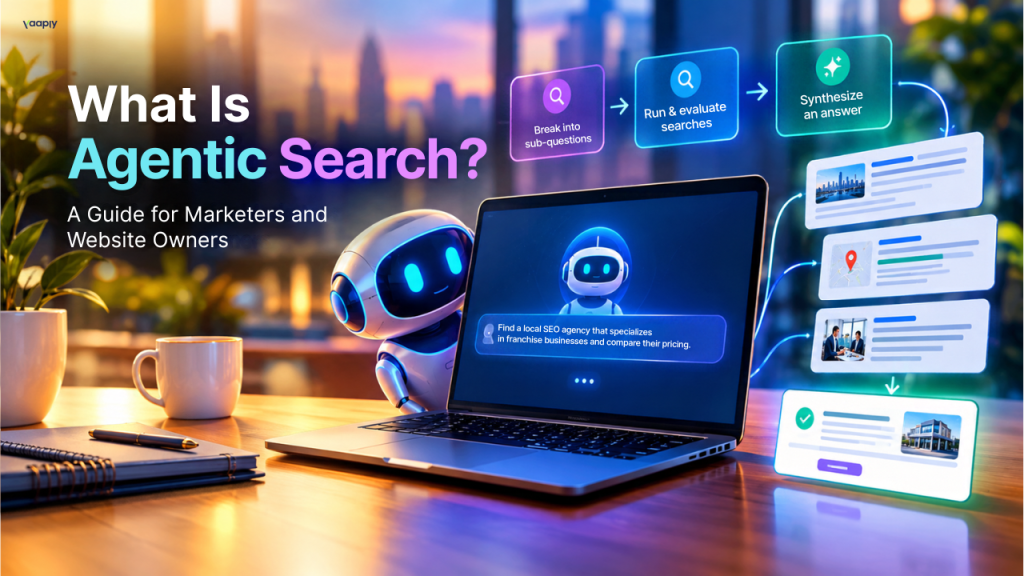
Last updated: September 2026.
Agentic search is when an AI agent, not a person, runs the search. Instead of a human typing a query and reading the results, the agent breaks a task into smaller questions, runs multiple searches on its own, reads what it finds, and decides whether it has enough to act on, whether that means answering a question or completing a purchase. For a business, that changes who your website actually needs to be readable to.
Quick Takeaways
- Agentic search is different from a zero-click AI Overview. In a zero-click search, a person still ran the query. In agentic search, an AI agent ran it on the person’s behalf, often without the person seeing any of the individual results.
- Google’s own SAGE research, published in January 2026, documents how AI agents already break complex queries into sub-questions and run multiple searches before responding.
- Every major write-up on agentic search so far has been written for developers building it into a product. This one is written for the business whose website that agent is now reading.
What Is Agentic Search?
Agentic search is a retrieval pattern where an AI agent plans its own searches instead of running one and stopping. Given a complex question or task, the agent breaks it into smaller sub-questions, searches for each one, reads and evaluates what comes back, and decides whether to search again, refine the query, or synthesize a final answer.
This is different from a standard search, where one query returns one set of results and a person reads through them. It’s also different from most AI Overviews, where a single AI-generated summary answers a single question. Agentic search can involve several searches, several sources, and several rounds of evaluation, all before the person on the other end sees anything.
How Agentic Search Works
Breaking the task into sub-questions. A request like “find a local SEO agency that specializes in franchise businesses and compare their pricing” doesn’t resolve from one search. The agent splits it into separate questions: which agencies specialize in franchise local SEO, what each one charges, and how they compare.
Running and evaluating each search. The agent searches for each sub-question, reads what comes back, and judges whether the results actually answer it. If they don’t, it reformulates the query and searches again rather than settling for a weak match.
Synthesizing an answer or taking action. Once the agent has resolved each sub-question, it puts together a final answer, or in some setups, takes the next step directly, like filling out a contact form or adding something to a cart.
The result is closer to how a person would actually research something themselves: several searches, some dead ends, some backtracking, then a conclusion, except it happens in seconds and the person only sees the outcome.
Agentic Search vs. Traditional Search vs. RAG
These three terms get used close together, and they’re not the same thing.
| Traditional Search | RAG | Agentic Search | |
| Who runs the query | A person | A retrieval system, against a pre-built index | An AI agent, in real time |
| Data source | The live web | A fixed, pre-indexed set of documents | The live web, searched on demand |
| Number of queries | One | One retrieval pass | Multiple, refined as needed |
| Freshness | Current at search time | Only as current as the last index update | Current at query time |
| Best fit | A person looking something up directly | Internal documents, stable reference material a business controls | Open-web research, comparisons, real-time information |
Traditional RAG (retrieval-augmented generation) retrieves a fixed set of results from an index built in advance, then hands them to a model to answer from. It works well for internal documents and stable content a company controls, but it can’t research something it was never given, and it can go stale the moment the source material changes. Agentic search has no fixed index. The agent searches the live web itself, which is why it’s the retrieval method behind most AI agents that research or compare things on the open web, including where to find or buy something.
Why Agentic Search Matters for Your Business
This is the part most technical write-ups on agentic search skip entirely, because they’re written for the people building the agents, not the businesses being searched.
Search volume through traditional channels is already shifting. Gartner has forecast a 25% drop in traditional search volume by 2026 as AI-driven search and agents take on more of the discovery work directly. Separate research from Bain & Company found that 80% of consumers now rely on AI-generated results for at least 40% of their searches. Some of that is a person reading an AI Overview. Increasingly, some of it is an agent doing the searching for them.
That shift changes what “ranking” means. A page can be well optimized for a human reader and still be invisible to an agent that can’t parse its structure, can’t confirm its claims against other sources, or gets blocked at the crawler level before it ever reads the page. The businesses an agent recommends, compares, or takes action on behalf of a user for are the ones whose content the agent could actually retrieve, read, and trust in the first place.
How to Optimize for Agentic Search
Optimizing for agentic search means making your content something an agent can retrieve, verify, and act on with confidence, not just something a person can read.
Make sure AI crawlers can actually reach your content. An agent can’t research your business if GPTBot, PerplexityBot, ClaudeBot, or similar crawlers are blocked in robots.txt, or if your key content only renders after heavy client-side JavaScript loads.
Answer the question directly, early. An agent evaluating whether a page answers its sub-question is looking for a clear, direct statement, not three paragraphs of setup before the point. State the answer in the first sentence or two under any heading.
Use structured data. Schema markup (Article, FAQPage, LocalBusiness, Product, whichever fits the page) gives an agent a machine-readable version of your content to verify against, instead of forcing it to parse prose to confirm a fact.
Put comparisons and specs in tables. An agent comparing options across several sources extracts structured data far more reliably than paragraphs. If your page is one of the sources being compared, a clear table is what gets read correctly.
Keep your facts consistent everywhere. An agent cross-checking a claim about your business, like pricing, service area, or specialization, will compare what it finds on your site against what it finds elsewhere. Inconsistent information across your website, directory listings, and social profiles reads as unreliable and gets deprioritized.
Build real third-party mentions, not just on-site claims. An agent trusts a claim more when it’s corroborated by an independent source. This is the same “neighborhood of trust” principle behind traditional link building, just applied to a reader that verifies before it recommends.
Frequently Asked Questions
What is agentic search in simple terms?
Agentic search is when an AI agent does the searching and comparing on a person’s behalf, running multiple searches, evaluating the results, and refining its approach, instead of a person running one search and reading the results themselves.
Is agentic search the same as an AI Overview?
No. An AI Overview answers one query with one AI-generated summary that a person still typed themselves. Agentic search can involve an agent running several searches across multiple sources before producing an answer or taking an action, often without the person seeing the intermediate steps.
Is agentic search the same as RAG?
No. RAG retrieves from a fixed, pre-built index of documents. Agentic search queries the live web in real time and can search repeatedly, refining its approach based on what it finds. Many production systems use both: RAG for stable internal data, agentic search for anything on the open web.
Can agentic search actually make a purchase?
In some setups, yes. Depending on how the agent is built, it can go beyond just returning an answer and complete an action directly, like filling out a form or placing an order, based on what it found during its research.
How is agentic search different from traditional SEO?
Traditional SEO optimizes for a person reading a page and a search engine ranking it. Agentic search adds a requirement on top of that: the page also needs to be something an agent can crawl, verify, and trust enough to act on, which puts more weight on structured data, consistent facts, and independent corroboration than on-page keyword optimization alone.
Getting cited by an AI agent depends on the same thing that gets you cited by a person doing a Google search: being a source other credible sites already point to. That’s what we do. If you want to know where your site currently stands, Yaaply can take a look.