
Last updated: October 2026.
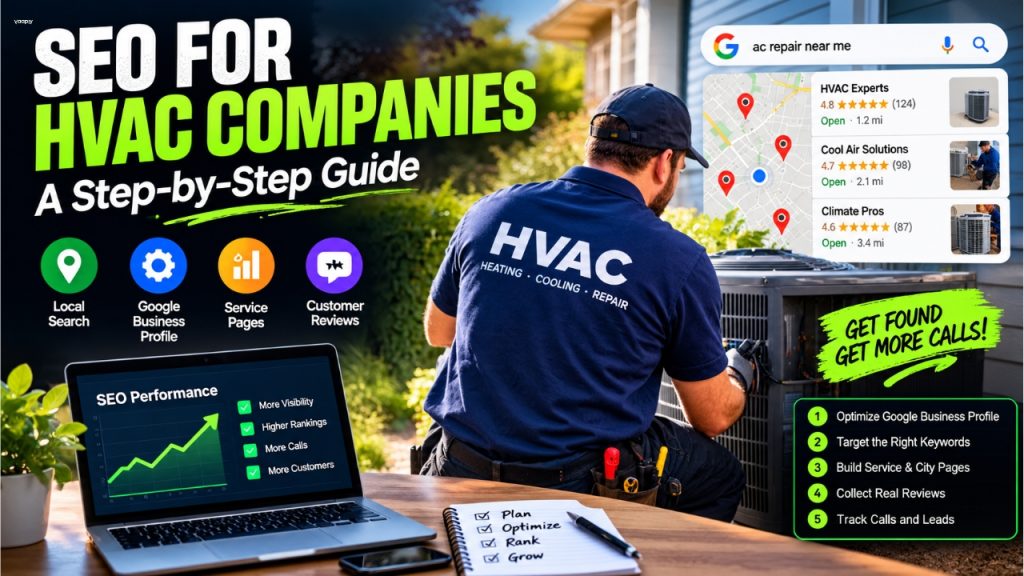
SEO for HVAC companies means showing up on Google when homeowners search for repair, installation and maintenance near them. Start with a complete Google Business Profile, build one page per service and city, collect real reviews and track calls, not clicks. Most companies that state a timeline say 3 to 6 months.
Quick Takeaways
- Google ranks local results on three things: relevance, distance and prominence. You control relevance and prominence. You do not control distance.
- Your Google Business Profile does more work than your website for “near me” searches, so fix it first.
- A service-area HVAC company should hide its address, keep one profile, and stay within about 2 hours of driving time, according to Google.
- Reviews help your ranking, but Google prohibits offering anything in exchange for them.
- You cannot pay Google for a better local ranking. Anyone who says they can is selling something else.
- Most of the HVAC SEO companies that publish a timeline say 3 to 6 months for real gains. Plan for that, and plan for your busy season.
What is SEO for HVAC companies?
SEO for HVAC companies is the work of making your business appear in Google results when someone needs heating or cooling work. It has two parts:
- The map pack: the three local listings with a map that appear for searches like “ac repair near me.” These come from your Google Business Profile.
- Organic results: the regular blue links below it. These come from your website pages.
HVAC is a good fit for SEO because many searches are local and some are urgent. A homeowner whose AC fails tends to call one of the first businesses they see. That is why this guide starts with the profile that feeds the map pack, and then moves to the website.
How does Google decide which HVAC company to show?
Google’s help page says “Local results are mainly based on relevance, distance, and popularity,” and then calls the third factor prominence. It defines each one:
- Relevance: “Relevance is how well a Business Profile matches what someone is searching for.”
- Distance: “Distance refers to how far each business is from the customer who’s searching.”
- Prominence: “Prominence means how well-known a business is.”
You cannot change where the customer is standing. You can change how well your profile matches the search, and how well-known you are. Every step below works on one of those two.
Google also states plainly: “There’s no way to request or pay for a better local ranking on Google.”
How do you do SEO for an HVAC company, step by step?
Follow these nine steps in order. The first three take a few weeks and cover most of the early gains.
Step 1: Set up and fix your Google Business Profile
This is the highest-value step, because the map pack comes from your profile. Check these items against Google’s own rules:
- Hide your address if you do not serve customers at your office. Google says “If you’re a service-area business, you should hide your business address from customers.”
- Keep one profile. A single service-area business “should have one profile for the central office or location with a designated service area.” If you have separate locations with their own staff, Google allows one profile for each.
- Keep the service area realistic. Google says it “shouldn’t extend farther than about 2 hours of driving time from where your business is based.”
- Use your real business name. Google says “Including unnecessary information in your business name isn’t permitted.” Do not add keywords, taglines or phone numbers.
- Pick a few, specific categories. Google says to “use as few categories as possible to describe your overall core business from the provided list.”
- Do not use a virtual office. A business that rents an address but does not operate there “isn’t eligible for a Business Profile,” and Google does not accept P.O. boxes or remote mailboxes.
- Fill in everything. Google says “Businesses with complete and accurate info are more likely to show up in local search results.” Add hours, phone, services, service areas and photos of your team, vans and finished work.
- Verify the profile. An unverified profile signals that you are not the confirmed owner.
Step 2: Choose the searches homeowners actually use
Group the searches by what the homeowner wants, not by what you want to sell:
| Group | Example searches | What the homeowner needs |
| Emergency and repair | “ac not cooling,” “furnace not turning on,” “ac repair near me” | Help today |
| Replacement and installation | “new ac installation,” “furnace replacement,” “heat pump install” | A quote and a trusted installer |
| Maintenance | “ac tune up,” “furnace maintenance,” “duct cleaning” | A fair price and a time slot |
Add your city and nearby towns to each group. Check volume in a keyword tool before you build pages, because volumes vary a lot by city, and we do not publish numbers for your market here.
Step 3: Build one page per service and per city
A single “Services” page cannot rank for every job in every town. Build separate pages instead:
- One page per service: AC repair, furnace repair, installation, heat pumps, maintenance plans.
- One page per city you serve, inside the area Google lets you list, with real content for that city.
Each page should have:
- A clear title with the service and the city, such as “AC Repair in [City]”
- A phone number and a click-to-call button at the top
- What the visit includes, how booking works and what a homeowner should expect
- Photos of your own work in that area, not stock images
- Real reviews from customers in that area
- A short list of questions homeowners ask, answered plainly
Do not copy the same text across city pages and swap the town name. That wastes the page and gives Google no reason to show it.
Step 4: Collect and answer reviews
Google says “More reviews and positive ratings can help your business’s local ranking,” and that prominence depends partly on how many reviews you have. Make asking part of every job:
- Ask right after work. Google’s guidance is to “Remind customers to leave reviews,” and says you can ask customers to visit a Google link or scan a QR code.
- Never offer anything in return. Google says offering incentives such as free or discounted goods or services for reviews “is considered fake & misleading content and is strictly prohibited.”
- Reply to every review. Google says replying shows you value feedback. Its own tips are to keep it short, be “conversational, not promotional,” apologize when appropriate for a bad experience and “respond in a timely manner.”
- Never share a reviewer’s private information or argue with them in public.
Step 5: Keep your business details the same everywhere
Use the same business name, phone number and service area on your website, your Google profile and any directory listing. Mismatched details make it harder for Google to trust which business is which. This step is common practice rather than a rule from Google, and it takes an afternoon.
Step 6: Fix the website basics
Google lists name and address as the required properties for LocalBusiness markup, and recommends adding opening hours and a telephone number. Its examples use JSON-LD. Beyond markup, check:
- Mobile first. Many homeowners search on a phone, so the call button should be visible without scrolling.
- Speed. A slow page loses an urgent caller. Test your main pages and fix the heaviest images.
- One clear action. Every page should make calling or booking obvious.
- No broken pages. Remove old pages that return errors, and redirect them to the closest live page.
Step 7: Publish content before each season
HVAC demand moves with the weather. W3Era’s page says content should be published well before the peak seasons so pages rank when demand rises, and A2Z Dev Center’s page stresses seasonal timing in the same way. Plan it like this:
| Season | Publish ahead of it | Page ideas |
| Before summer | Cooling | AC tune-up, AC not cooling, new AC installation |
| Before winter | Heating | Furnace tune-up, furnace not heating, heat pump options |
| Year-round | Maintenance | Maintenance plans, indoor air quality, duct cleaning |
Write each page for a homeowner with one question. Answer it in the first two sentences, then add detail.
Step 8: Earn links from real local sources
Links from other sites help your prominence. Focus on links that are real and local:
- Local organizations you already belong to: chambers of commerce, trade associations and business groups often list members with a link.
- Sponsorships and events: a local team or event page that thanks sponsors usually links to them.
- Manufacturer and supplier pages: if you are an authorized dealer or installer, ask for a listing.
- Local news and community sites: a useful, factual tip about seasonal home care can earn a mention.
Be careful with paid links. Google’s spam policy prohibits “buying or selling links for ranking purposes.” If you pay for a link, Google says it should carry a rel=”sponsored” or rel=”nofollow” attribute. Our guide to niche edits explains how paid link placements work and how to vet one.
Step 9: Track calls and booked jobs
Rankings do not pay your bills. Track what does:
- Calls from your Google Business Profile and from your website
- Booked jobs from those calls
- Which service pages and cities bring the calls
One HVAC SEO company on our list, Honest HVAC Marketing Agency, says it reports on “calls that became jobs.” That is the standard to hold anyone to, including yourself.
How long does SEO for HVAC companies take?
Most companies that state a timeline say 3 to 6 months for significant gains. These are the timelines stated on the companies’ own pages, checked on October 5, 2026:
| Company | What its page says |
| D&D SEO Services | Map pack improvements in 4 to 6 weeks, organic growth in 3 to 6 months |
| A2Z Dev Center | Google Business Profile results in 30 to 60 days, service pages and local authority over 3 to 6 months |
| Honest HVAC Marketing Agency | “Local SEO for an HVAC contractor takes three to six months,” with calls usually rising by the end of month two |
| HVAC Marketing Xperts | “HVAC SEO results typically take 3 to 6 months to see significant improvements” |
| W3Era | Measurable gains within 3 to 4 months |
| Hook Agency | A shift in 1 to 3 months and significant ROI in 6 to 8 months |
These are company claims, not guarantees, and they depend on your market. A small town with few competitors can move faster than a large city.
Should you do HVAC SEO yourself or hire a company?
You can do steps 1, 4 and 9 yourself, and many owners do well with that. Hiring help makes more sense for the work that takes ongoing time: building many pages, fixing technical problems and earning links.
| Work | Do it yourself | Hire help |
| Fix and fill in your Google Business Profile | Yes | Optional |
| Ask for and reply to reviews | Yes, it works best from you | Optional |
| Track calls and booked jobs | Yes | Optional |
| Service and city pages | Possible, but slow | Often worth it |
| Technical fixes and markup | Depends on your skills | Often worth it |
| Link building | Hard to do at scale | Often worth it |
If you hire, know what the market charges. Among the companies we reviewed in our ranking of the 10 best HVAC SEO companies, starting prices ran from $99 to $3,000 per month, and five of the nine that state one fell between $499 and $1,297. Eight of the ten pages say month-to-month, no contracts or no long-term contract. Prices change, so check each company’s page.
Ask any company what the price includes, how long the term is, and how it reports calls and booked jobs. A price that says “call for details,” or a promise of a ranking, is a reason to ask more questions.
What mistakes should HVAC companies avoid?
Most of these come straight from Google’s own rules:
- Offering a discount for a review. Google says it is “strictly prohibited.”
- Stuffing keywords into your business name. Google says unnecessary information in a business name “isn’t permitted.”
- Using a virtual office or P.O. box as your address. Google says it makes you ineligible.
- Listing a service area far larger than you cover. Google’s guideline is about 2 hours of driving time.
- Copying the same city page 20 times. It adds nothing for a homeowner or for Google.
- Paying anyone for a “guaranteed” ranking. Google says there is no way to pay for a better local ranking.
- Tracking rankings and ignoring calls. A first-page ranking that brings no calls is not a result.
A 30-day starting plan
| Week | Task | Done when |
| 1 | Fix and verify your Google Business Profile | Name, categories, service area, hours and photos are complete |
| 2 | Build or fix your top service pages | Each page has a title, phone number, photos and answers |
| 3 | Start asking for reviews after every job | You have a link or QR code and a reply routine |
| 4 | Set up call tracking | You can see calls and booked jobs by page and city |
After the first month, add city pages and seasonal content, then start link building.
FAQ
How much does SEO for an HVAC company cost?
If you do it yourself, the cost is mostly your time. If you hire help, the companies we reviewed publish starting prices from $99 to $3,000 per month, with five of nine between $499 and $1,297. Prices vary by scope and by what is bundled, so confirm on each company’s page.
How long does it take for HVAC SEO to work?
Companies that state a timeline say 3 to 6 months for significant gains. Google Business Profile and map pack improvements can show sooner, with D&D SEO Services saying 4 to 6 weeks and A2Z Dev Center saying 30 to 60 days.
Is local SEO different from regular SEO for HVAC?
For an HVAC company, local SEO is most of the work, because customers search for help near them. Google’s local results depend on relevance, distance and prominence, so your Google Business Profile, reviews and city pages matter as much as your website.
Do I need a physical office to use Google Business Profile?
Not if you are a service-area business. Google says to hide your address if you serve customers at their location. A virtual office or P.O. box does not qualify.
Can I pay Google to rank higher in the map pack?
No. Google says “There’s no way to request or pay for a better local ranking on Google.” You can run paid ads separately, but they do not change your local ranking.
Do reviews really affect HVAC rankings?
Yes. Google says “More reviews and positive ratings can help your business’s local ranking.” Ask every customer, reply to every review and never offer anything in exchange.
Sources
- Google Business Profile Help: Tips to improve your local ranking
- Google Business Profile Help: Guidelines for representing your business
- Google Business Profile Help: Read and reply to reviews
- Google Search Central: Local business structured data
- Google Search Central: Spam policies for Google web search
- A2Z Dev Center: SEO Services for HVAC Companies
- D&D SEO Services: HVAC SEO Services
- Honest HVAC Marketing Agency: HVAC SEO Agency
- HVAC Marketing Xperts: HVAC SEO Services
- W3Era: HVAC SEO Services
- Hook Agency: HVAC SEO Services
Want editorial backlinks that point to your HVAC service pages, with every link listed in a report you can check? Yaaply builds link placements on relevant sites for HVAC businesses and the agencies that serve them. Talk to Yaaply