
The 10 best SaaS SEO agencies in North America do something a generalist marketing shop usually cannot: they understand that your buyer is a technical evaluator comparing four products in a spreadsheet, not a shopper looking for the cheapest option. That difference shows up in keyword strategy, in how comparison and alternatives pages get built, and in whether your content ever earns a link worth having.
It matters more in 2026 than it did two years ago. A growing share of technical research now starts inside AI Overviews, ChatGPT, and other answer engines, where the question is not just whether you rank but whether you get cited. Getting cited is largely a function of being the source other credible sources point to, which is why link quality and original data have quietly become the center of SaaS SEO rather than a side project.
One note on how this list was built. Every agency here has a genuine, independently verifiable review presence on a third-party platform, not just a self-published “best of” post naming itself first. Several well-known names were left out for exactly that reason.
1. Directive Consulting
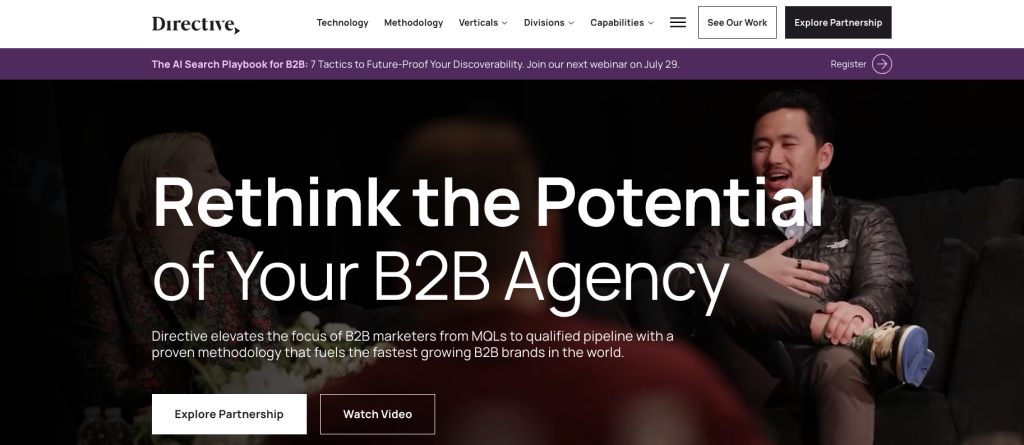
Core Strength: Directive is built as a B2B SaaS marketing agency rather than a generalist, and its “Customer Generation” methodology ties SEO, paid media, and creative directly to qualified pipeline instead of traffic or MQL counts. Public materials cite more than 420 brands served and aggregate revenue influence measured in the billions.
Why Choose Them: Pick Directive when you run a sales-led motion and your board asks about pipeline contribution, not sessions, and when you want organic and paid planned as one system rather than two separate line items.
What Makes It Different: Single Grain works across SaaS, tech, and ecommerce. Directive stays inside B2B, which means less range but more pattern recognition in your specific category.
Pros & Cons: The clear advantage is revenue accountability baked into how engagements are scoped and reported. The honest limitation is that engagements are retainer-based with no public rate card, so you cannot size the investment without a sales conversation.
Website: Directive Consulting
2. Single Grain
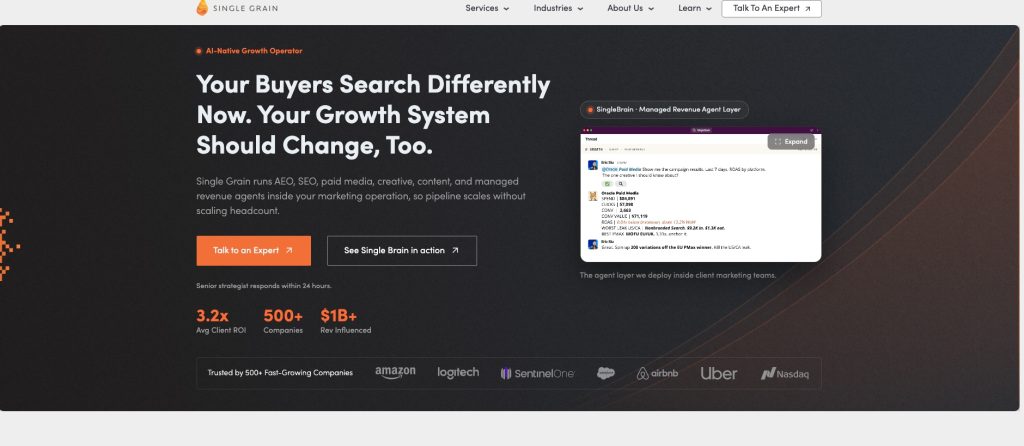
Core Strength: Founded in 2014 and led by CEO Eric Siu, this Los Angeles agency runs full-funnel growth across SEO, paid media, content, CRO, and analytics, with AI-driven optimization layered on top. The named client roster includes Amazon, Uber, Salesforce, Nextiva, and Drift, and its Clutch rating sits in the 4.7 to 4.8 range.
Why Choose Them: Choose Single Grain when you need one partner covering organic, paid, and conversion work together, and when having recognizable enterprise logos on the team’s resume matters to your stakeholders.
What Makes It Different: Scalerrs is SaaS-exclusive and organized into small dedicated pods. Single Grain deliberately works across SaaS, tech, and ecommerce, trading category depth for channel breadth.
Pros & Cons: The advantage is genuine multi-channel coverage from a team with proven enterprise experience. The limitation is that SaaS is one vertical among several here, so category-specific instinct may be thinner than at a specialist shop.
Website: Single Grain
3. Siege Media
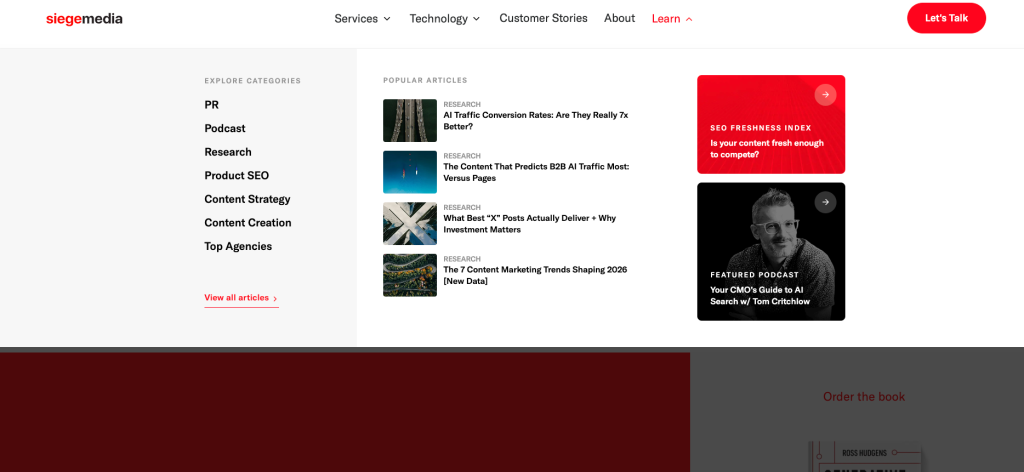
Core Strength: Siege pairs content-led SEO with strong design and digital PR, and it has an explicit SaaS GEO offering built around AI Overview visibility and citations. It holds the strongest independently verified review profile in this group at 4.9 out of 5 across roughly 46 to 47 Clutch reviews.
Why Choose Them: This is the pick when your goal is being cited inside AI answers and referenced by credible publications, not just ranking a blog post, and when you want content that earns links on its own merit.
What Makes It Different: Codeless is a volume production system. Siege attaches design and digital PR to every content investment, which is slower per asset but far more link-worthy.
Pros & Cons: The advantage is the best-verified reputation on this list combined with real AI search focus, including a client case page reporting tens of thousands of AI Overview citations and near-total visibility in LLMs for industry-specific queries. The limitation is that those case figures are self-published, and the practice leans content and PR rather than deep technical SEO.
Website: Siege Media
4. Omniscient Digital
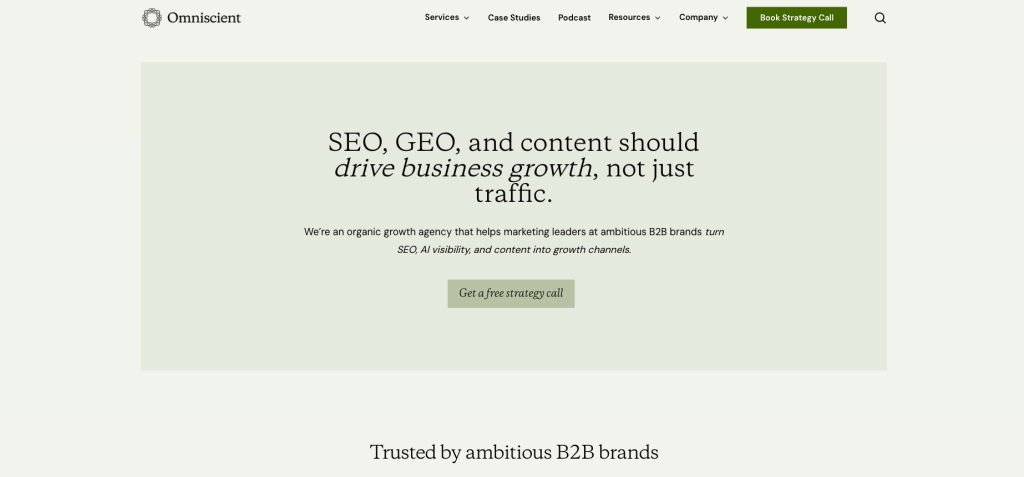
Core Strength: This Austin-based organic growth agency works specifically with B2B software companies, combining SEO, GEO, content production, and digital PR. It is strategy-led rather than execution-first, connecting organic and AI search to pipeline, and it is one of the few firms here that publishes pricing openly rather than gating it behind a sales call.
Why Choose Them: Omniscient fits when you already have writers or an in-house marketer and what you actually lack is a defensible strategy and someone senior to hold the plan accountable.
What Makes It Different: Directive plans SEO alongside paid media as one revenue engine. Omniscient stays focused on organic and AI search, going deeper on one channel instead of wider across several.
Pros & Cons: The advantage is transparent, sales-call-free pricing plus a genuine B2B software focus, which is a rare combination. The limitation is a thin verified review base, roughly five to eight Clutch reviews, so there is less third-party evidence than at Siege Media or Victorious.
Website: Omniscient Digital
5. Stratabeat

Core Strength: Stratabeat is a Boston B2B agency built entirely around compounding organic growth for SaaS and tech companies. Its distinctive angle is applying neuroscience and behavioral-analytics principles to content and website design, tracking which net-new logos visit a client site and what they do once there.
Why Choose Them: Go here when your content ranks but does not convert, or when you suspect your site is winning traffic and losing the buyer somewhere between the blog post and the demo request.
What Makes It Different: Codeless is engineered for publishing volume. Stratabeat caps each strategist at three or fewer clients, which is the opposite trade: fewer assets, far more senior thinking behind each one.
Pros & Cons: The advantage is unusually deep attention plus a documented case showing a 1,604% increase in organic traffic for one client. The limitation is that the client cap restricts availability, and the review base of eleven to twelve is modest next to the largest firms here.
Website: Stratabeat
6. Scalerrs
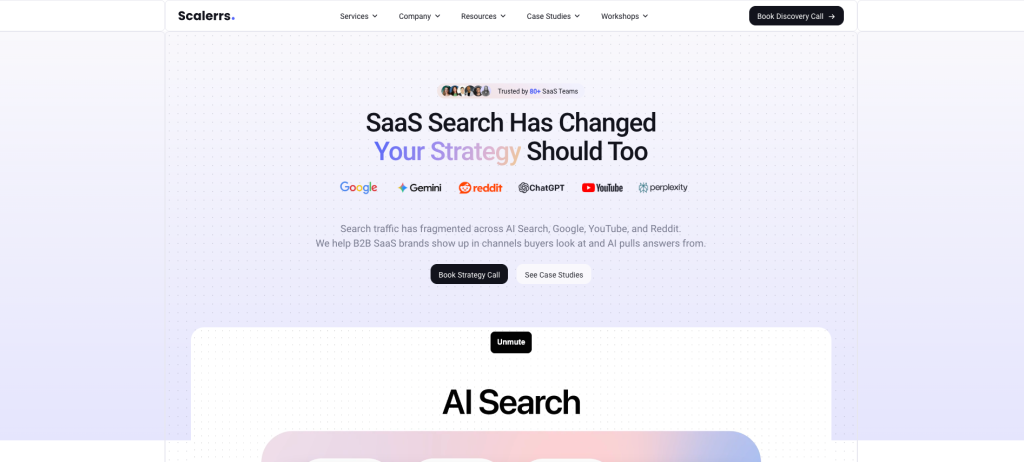
Core Strength: Scalerrs is a San Francisco agency working exclusively with SaaS companies on SEO, AEO, and content, organized around dedicated client pods. Every piece of content is tied to a specific outcome: ranking on Google, getting cited in an LLM, or moving a prospect closer to a decision.
Why Choose Them: This is a strong fit when you want a partner that behaves like an extension of your own team rather than a vendor, which is exactly how its Clutch reviewers describe the experience.
What Makes It Different: NP Digital delivers at enterprise scale across multiple regions. Scalerrs is small, embedded, and SaaS-only, which means more continuity but less horsepower for a global rollout.
Pros & Cons: The advantage is the pod structure, which keeps the same people on your account instead of rotating juniors through it. The limitation is a small verified footprint, with only five Clutch reviews on record so far.
Website: Scalerrs
7. Codeless
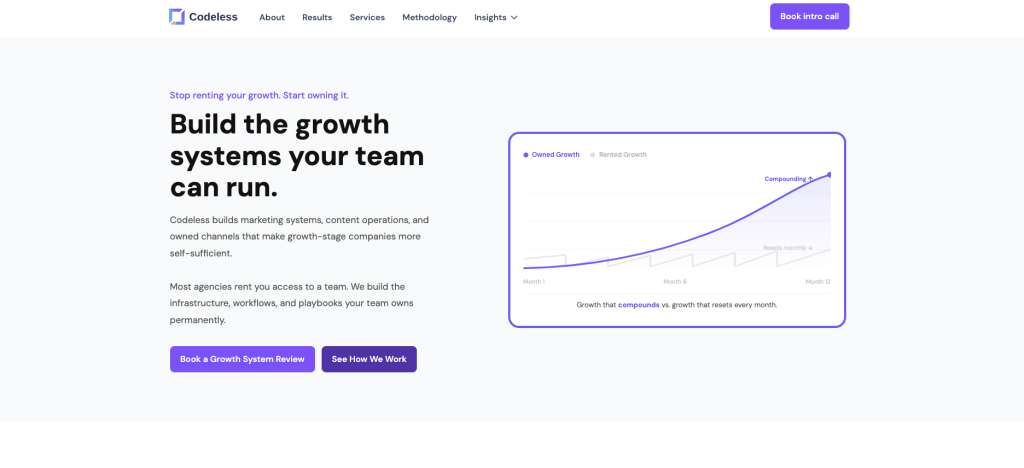
Core Strength: Codeless is a content operations agency built for growth-stage SaaS companies that need to scale publishing fast. Rather than a boutique strategist model, it runs a system of niche writers, editors, designers, and account managers. Its clearest proof point is client monday.com, which grew from 12,586 to 304,000 monthly blog visitors on the back of more than 950 Codeless-produced articles.
Why Choose Them: Choose Codeless when your strategy is already validated and the real bottleneck is throughput, meaning you need dozens of quality articles shipped per month without hiring a content team.
What Makes It Different: Stratabeat caps strategists at three clients for maximum depth. Codeless optimizes for the opposite: a repeatable production line that holds quality at volume.
Pros & Cons: The advantage is a proven publishing scale that very few SaaS content marketing agencies can match. The limitation is that engagements typically carry six-month minimum terms, and with five Clutch reviews the independent evidence base is still thin.
Website: Codeless
8. Sure Oak
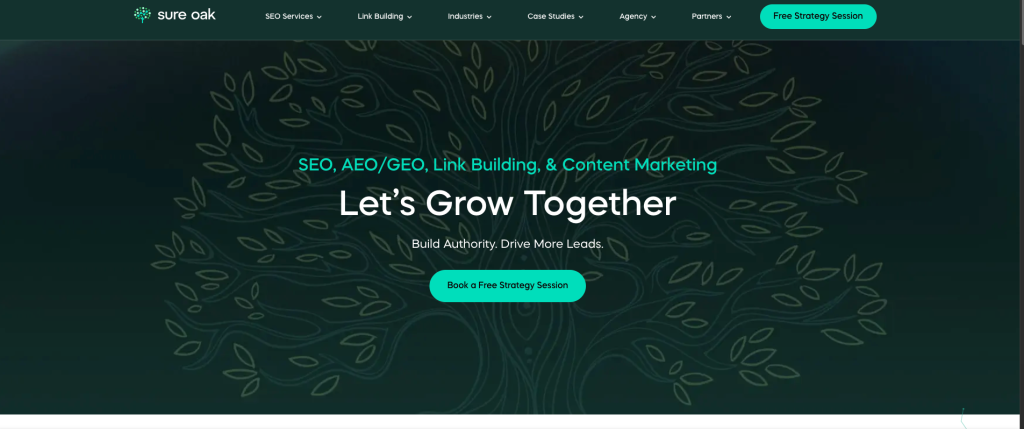
Core Strength: Operating out of Brooklyn since 2017, Sure Oak now positions itself as an enterprise SEO and GEO growth agency, explicitly focused on organic visibility across both traditional search and AI systems including ChatGPT, Gemini, and Claude. It works with technology, finance, and business-services clients.
Why Choose Them: Sure Oak suits larger organizations with multiple stakeholders and approval layers, where the agency needs enough process maturity to handle complex sign-off rather than working directly with one founder.
What Makes It Different: Omniscient Digital has a handful of verified reviews. Sure Oak carries 39 Clutch reviews, the second-strongest count in this group, which gives you a much larger evidence base to read before signing.
Pros & Cons: The advantage is that combination of deep review history and genuine AI search positioning. The limitation is that roughly 90% positive sentiment means some mixed feedback exists in that record, and the practice is not SaaS-exclusive.
Website: Sure Oak
9. Victorious
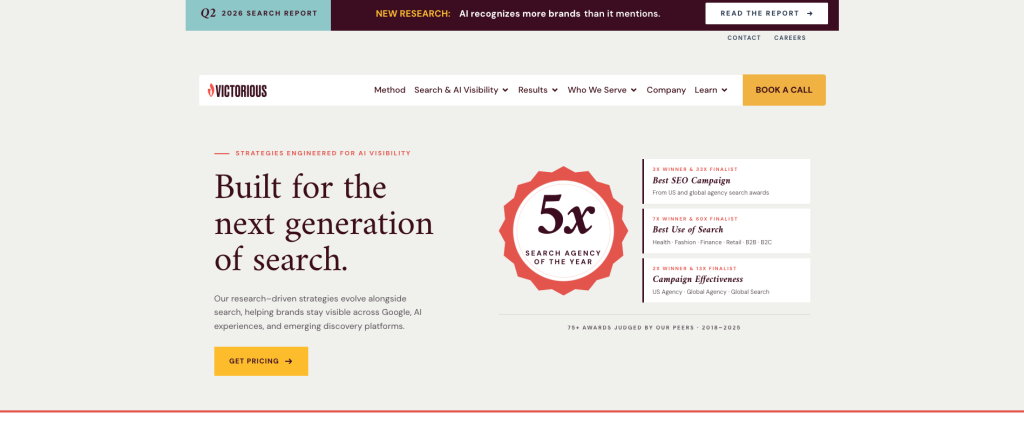
Core Strength: Victorious pivoted in 2016 to focus exclusively on SEO rather than broad digital marketing, and it targets SaaS, finance, AI, and enterprise tech clients with technical SEO, Answer Engine Optimization, and link acquisition. Reporting runs in real time and is tied to MRR and visibility goals rather than vanity metrics.
Why Choose Them: Pick Victorious when you want an SEO-only partner and you care about being able to check performance yourself without waiting for a monthly deck.
What Makes It Different: Single Grain spreads across SEO, paid, and CRO. Victorious does one channel and has the largest verified review based on this entire list at 119 Clutch reviews, which is an unusual amount of public accountability.
Pros & Cons: The advantage is that review volume, which makes it easier to sanity-check claims before you commit. The limitation is the narrow channel scope, so paid media and lifecycle marketing will need another partner or an in-house owner.
Website: Victorious
10. NP Digital
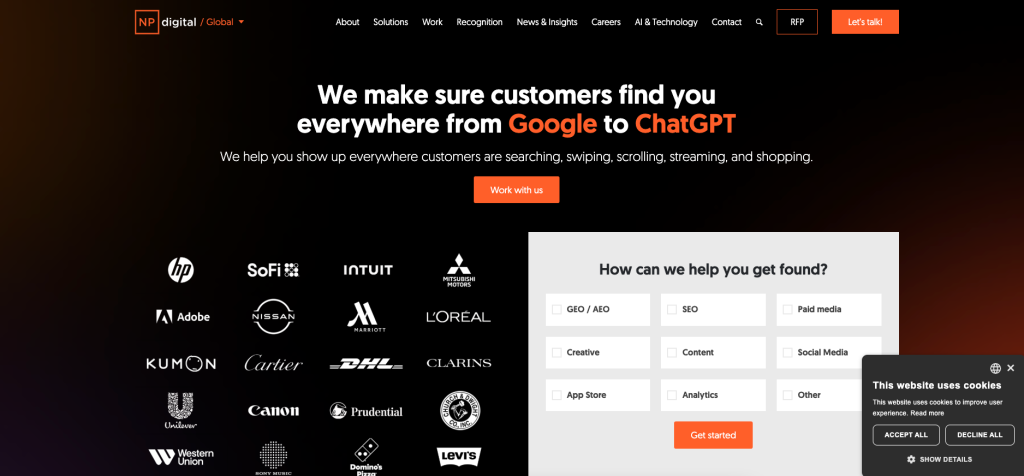
Core Strength: Co-founded by Neil Patel and based in San Diego, NP Digital delivers SEO, paid media, content, and social at enterprise scale across North America, Europe, and APAC. Very few agencies on this list can staff a coordinated program across three regions at once.
Why Choose Them: This is the option when you are running a multi-region rollout and need consistent search execution in several markets and languages under one contract and one reporting structure.
What Makes It Different: Scalerrs and Omniscient Digital are small, focused boutiques where you know everyone on the account. NP Digital trades that intimacy for reach and infrastructure.
Pros & Cons: The advantage is global footprint and the operational depth that comes with it. The limitation is that its Clutch profile shows 4.5 out of 5 across 18 reviews, which is both the lowest rating and the thinnest review count relative to company size in this group.
Website: NP Digital
How to Narrow This List
Start with what kind of partner your stage actually needs. If you are a SaaS company that wants a team living inside your category every day, look first at the SaaS-exclusive boutiques: Scalerrs, Directive Consulting, and Stratabeat. You will get sharper category instinct and more senior attention, and you will give up scale and channel breadth to get it.
If you need SEO working alongside paid media, social, or multi-region execution, the larger multi-channel agencies fit better. Victorious, NP Digital, and Single Grain all have the headcount and the systems for that, and Victorious in particular gives you the deepest public review trail of anyone here if third-party validation is part of your due diligence.
If your strategy is already settled and the gap is production, Codeless and Siege Media are the two clearest choices. Codeless is the answer when you need volume shipped reliably. Siege Media is the answer when each asset needs to earn links and citations on its own.
One last filter worth applying: ask any agency you shortlist how they earn links, not how many they build. In an AI search environment, citations follow credibility, and credibility does not come from a placement network.
At Yaaply, that is the part we focus on, earning links and mentions from sources that AI systems and human buyers both treat as trustworthy. If you want a second opinion on where your organic visibility is actually leaking, we are happy to take a look.