
Digital PR Agencies Dominating AI Search have moved from a nice-to-have to a core part of how brands stay visible online. ChatGPT, Gemini, Perplexity, and Google AI Overviews do not rank pages the way traditional search once did. They pull from a web of earned mentions, third-party citations, and entity signals scattered across trusted publications, and they decide who gets surfaced based on how consistently a brand shows up in that web.
That shift has put digital PR agencies in a new position. The same earned media placements that used to build brand awareness now double as the raw material AI systems use to verify a brand exists, understand what it does, and decide whether it is worth citing. A mention in a trusted outlet is no longer just a reputation win. It is a data point an AI model can reference.
We think about links the same way at Yaaply: every placement is a citation an AI engine can eventually point to, not just a ranking signal. With that context, here are ten digital PR agencies worth knowing if AI search visibility is on your radar for 2026.
1. Bospar
Core Strength: Bospar built dedicated GEO and AEO service lines specifically to help B2B technology, AI, and cybersecurity companies build the consistent web footprint large language models use for entity recognition.
Why Choose Them: Bospar fits a B2B tech or cybersecurity company that wants executive thought leadership tied to measurable share-of-voice gains, not just press hits. Their documented HRtech case study started from a baseline of just four media mentions and three percent market share before the engagement began.
What Makes It Different: Unlike FINN Partners, which operates as a large integrated global firm across many industries, Bospar stays virtual-first and focuses almost entirely on B2B technology and AI clients.
Pros & Cons: Strong industry recognition, including a PRSA Silver Anvil win and a spot on the Inc. 5000 list. The tradeoff is a narrow sector focus that will not suit consumer or non-tech brands.
Website: Bospar
2. Landis Communications
Core Strength: Landis has spent over thirty years building relationships across consumer, healthcare, technology, and LGBTQ+ sectors, and now runs formal AI visibility audits tracking brand citations, sentiment, and citation quality across ChatGPT, Gemini, and Perplexity.
Why Choose Them: A healthcare or consumer brand that wants a boutique partner with a long track record and a program built to show a clear return, not just press clips. One client testimonial credits the agency with a substantial earned ad equivalence value from its PR program.
What Makes It Different: Both Landis and Bospar run as boutique shops, but Landis works across several sectors while Bospar stays exclusively in B2B tech.
Pros & Cons: Well regarded regionally, named America’s number one small PR firm by Ragan’s Ace Awards and listed among Forbes’ top two hundred agencies. The team is under twenty five people, which caps how much volume they can take on at once.
Website: Landis Communications
3. SlicedBrand
Core Strength: SlicedBrand is built almost entirely around the AI industry, with Tier-1 tech media relationships that overlap heavily with the sources large language models tend to cite.
Why Choose Them: A stealth AI startup or an enterprise AI division, in the mold of clients like Microsoft and Google, that needs a team fluent enough in the technology to translate a complex product into a story journalists will actually run.
What Makes It Different: SlicedBrand and Proper Propaganda are both AI-native boutiques, but SlicedBrand leans on deep tech media relationships while Proper Propaganda leans on its own proprietary measurement framework.
Pros & Cons: Founder Ayelet Noff has been named one of Business Insider’s fifty best PR people in tech, and the agency holds a perfect average rating on G2. The agency is based in Zurich and Berlin, which means less on-the-ground presence in the US media market.
Website: SlicedBrand
4. Fractl
Core Strength: Fractl runs on what it calls a scientific approach to PR, building original research, commissioned surveys, and data analysis specifically engineered to earn journalist coverage.
Why Choose Them: A brand that wants a large volume of earned links tied directly to organic traffic growth. Client McAfee received forty high-quality articles in six months that generated over fifteen thousand clicks in a single month, and client HeliosX saw more than two hundred fifty percent year-on-year SEO traffic growth alongside over five hundred earned links.
What Makes It Different: Fractl’s edge comes from proprietary research-driven storytelling, while SHIFT Communications relies more on proprietary data tools that track how existing messaging spreads.
Pros & Cons: Ranked number one for content marketing out of thirty thousand firms on Clutch’s Leaders Matrix. The research-first approach can take longer to produce results than straightforward media relations work.
Website: Fractl
5. FINN Partners
Core Strength: FINN Partners is one of the largest independent global PR firms, and it runs a dedicated GEO practice built to establish brand discoverability across multiple markets and languages at the same time.
Why Choose Them: An enterprise or multinational brand that needs a coordinated international campaign rather than a single-market push. FINN holds leading positions specifically in education, travel, and purpose and CSR work.
What Makes It Different: FINN operates at a scale SHIFT Communications does not match, with over a thousand staff globally compared to SHIFT’s regional US office footprint.
Pros & Cons: Ranked by O’Dwyer’s among the top five to six US PR firms by worldwide fees, ahead of roughly one hundred thirty competing firms. That scale can come with less individualized attention than a boutique like Landis or Vitis PR offers.
Website: FINN Partners
6. SHIFT Communications
Core Strength: SHIFT runs proprietary data tools that track how brand messaging spreads across the web and identify which content formats actually drive AI citation and entity recognition over time.
Why Choose Them: A mid-size company that wants integrated communications backed by real enterprise experience. Named clients include Citrix, McDonald’s, and McKesson.
What Makes It Different: SHIFT and Gregory FCA both build proprietary tracking tools, but Gregory FCA’s system is purpose-built for financial services while SHIFT serves a broader mix of industries.
Pros & Cons: An established agency, founded in 2003, with offices in Boston, New York, San Francisco, and Minneapolis. Published case study detail on AI-specific outcomes is thinner than what Bospar or Landis have made public.
Website: SHIFT Communications
7. Gregory FCA

Core Strength: Gregory FCA’s “Influence Engine” methodology combines earned media with prompt analysis and audits of brand visibility across ChatGPT, Gemini, Perplexity, Google AI, and Microsoft Copilot.
Why Choose Them: A financial services, fintech, or real estate brand that needs sector-specific credibility. Named clients include M&T Bank, Morgan Properties, and Allianz.
What Makes It Different: Gregory FCA and Bospar both offer formal AI visibility audits, but Gregory FCA specializes in financial services while Bospar specializes in B2B technology.
Pros & Cons: Named to PR News’ Agency Elite Top 100 for three consecutive years and recognized as PR Daily’s Content Marketing Agency of the Year. The sector focus makes it a weaker fit for consumer brands outside finance, tech, or real estate.
Website: Gregory FCA
8. Proper Propaganda
Core Strength: Proper Propaganda positions PR as the “input layer” for AI systems, running proprietary GEO measurement metrics it calls Share of Answer, Brand Citation Rate, and Prompt Coverage.
Why Choose Them: A consumer tech or AI brand that wants granular, trackable AI-visibility metrics. An independent AI-visibility tracker, Scrunch, corroborated a fivefold increase in lead generation the agency documented for one client.
What Makes It Different: Proper Propaganda’s edge is its proprietary measurement framework, while SlicedBrand’s edge is deep tech media relationships and technical fluency.
Pros & Cons: All-senior team with an independently corroborated case study. It is a small Montreal boutique with under twenty five staff and a limited public track record beyond that one client.
Website: Proper Propaganda
9. Search Intelligence
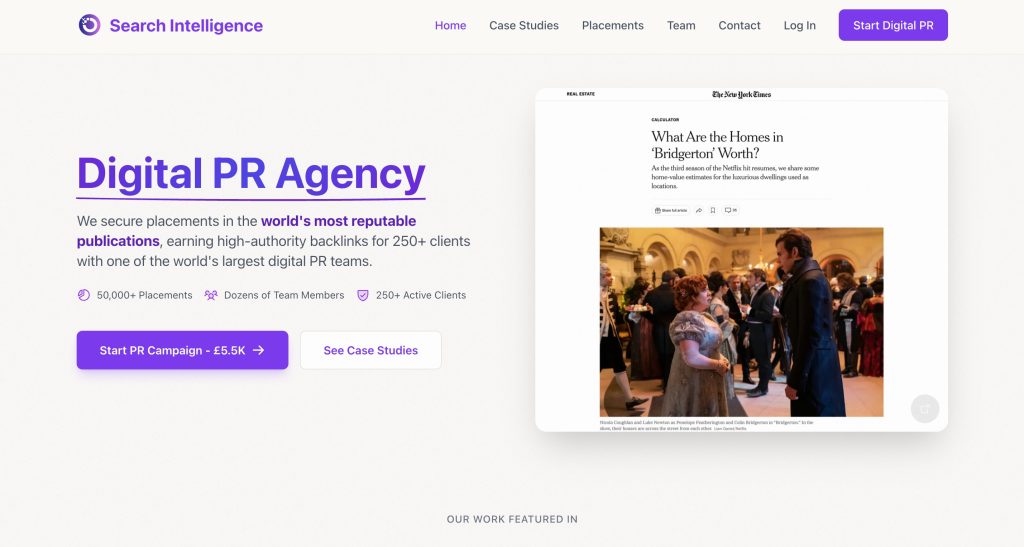
Core Strength: Search Intelligence runs one of the largest digital PR teams in the UK, built around reactive newsjacking that tracks Google Trends, breaking news, and social chatter to land placements while a story is still hot.
Why Choose Them: A brand that wants high link velocity across many campaigns running in parallel. The agency has worked with over two hundred fifty active clients and reports more than fifty thousand total placements, including a campaign built specifically around ChatGPT search behavior that landed over sixty links and placements.
What Makes It Different: Unlike Fractl, whose research-first model favors depth over speed, Search Intelligence is built for speed, launching reactive campaigns the same week a trend breaks rather than spending months building a single data study.
Pros & Cons: Named placements in its published case studies include Daily Mail, Huffington Post, and The Sun, and the agency runs on a no-lock-in, campaign-by-campaign model. The tradeoff is thinner independent verification than most agencies on this list. Its Clutch profile currently has no submitted reviews, so its scale claims rest mainly on its own case studies rather than third-party corroboration.
Website: Search Intelligence
10. Avenue Z

Core Strength: Avenue Z brands itself around “AI Optimization,” pairing performance PR with search-visibility work meant to build influence from ChatGPT to traditional outlets to TikTok.
Why Choose Them: A consumer or beauty brand that wants a documented commercial outcome, not just impressions. A campaign for client MONAT was tied to a significant lift in TikTok Shop sales.
What Makes It Different: Avenue Z’s proof point is a social commerce outcome tied directly to platform sales, while Fractl’s proof points center on earned links and organic traffic growth.
Pros & Cons: A 2025 New York office expansion signals real growth momentum. Its fifteen verified Clutch reviews are fewer than Fractl’s thirty four plus.
Website: Avenue Z
Which one fits your brand
If you want a boutique partner built entirely around AI, SlicedBrand and Proper Propaganda are the strongest fits, though one leans on media relationships and the other on proprietary measurement. If you need scale across multiple markets, FINN Partners and SHIFT Communications are built for that kind of coordinated, larger campaign. If your priority is data-driven storytelling that produces measurable traffic and link growth, Fractl’s research-first model is hard to match. Sector fit matters too. Gregory FCA is the clear pick for financial services, and Vitis PR or Bospar make sense if your product lives squarely in tech or AI.
Whichever agency you choose, the placements they earn only matter if they hold up as citations AI systems trust. That is the same standard we hold every link to at Yaaply, where earned, editorial placements are built to work as citations, not just backlinks.