
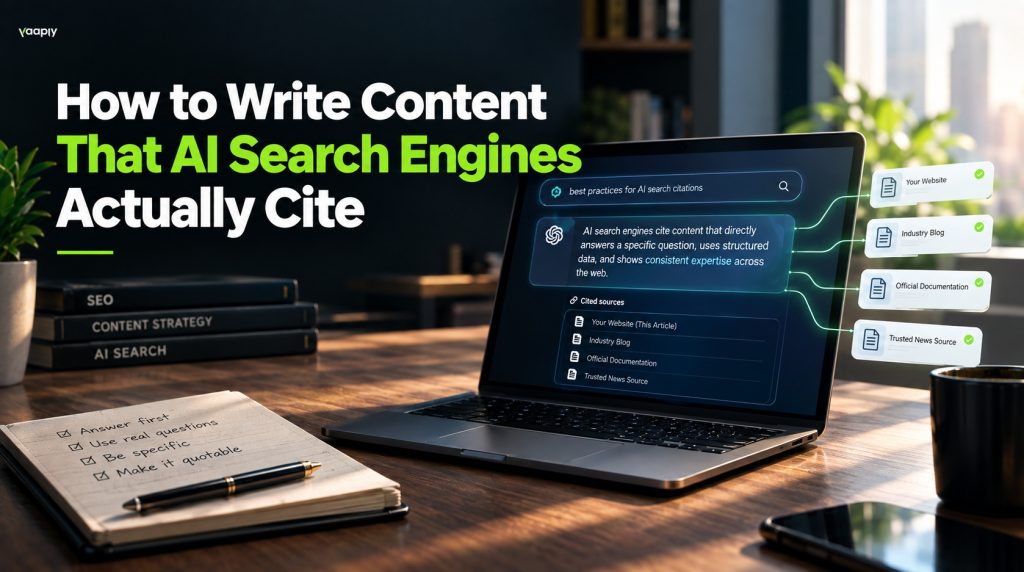
Quick answer: How to write content that AI search engines actually cite comes down to sentence-level habits, not a new content type. Lead every section with its conclusion instead of its setup, write headers the way people actually phrase a question, make each paragraph self-contained enough to be lifted on its own, and replace vague adjectives with specific numbers, dates, and names. A model can only quote what’s already written as a quotable, standalone sentence, and most content simply never gets written that way.
Why Traditional SEO Writing Doesn’t Get Cited
Most blog content is still written the way SEO rewarded it a decade ago: an intro paragraph that restates the title, a “in this post we’ll cover” preamble, and the actual answer buried three or four paragraphs in, after enough keyword-rich throat-clearing to satisfy an old-school word count target. That structure works fine for a human skimming toward a heading. It fails completely for a model that’s scanning a page looking for one extractable passage to lift into an answer. If the direct answer isn’t near the top of the section, the model moves to a competitor’s page that gets to the point faster.
Lead With the Answer, Then Support It
Every section should open with the conclusion, not the runway. If a reader (or a model) read only the first sentence of a section and nothing else, that sentence should still be a complete, correct answer to the implied question. Everything after it is supporting detail: the “why,” the caveats, the example. This is the exact opposite of how most writers are taught to build an argument, which is to build up to a conclusion. For AI-citation writing, the conclusion comes first every time.
Write Headers the Way People Actually Ask the Question
If someone would type “does ChatGPT use Google’s index” into a chat window, your header should be “Does ChatGPT Use Google’s Search Index?” and not something like “Understanding Search Infrastructure Differences.” Match the phrasing of the question, not the abstract topic underneath it. This does double duty: it helps a model match your section to the exact query it’s trying to answer, and it makes the page easier for a human to scan for the one section they actually need.
Make Every Section Self-Contained
A model typically lifts one paragraph or one section out of a page, not the whole article, so that section needs to make sense with zero context from anything above it. In practice, that means:
- Spell out the entity by name in every section, instead of relying on “it” or “this tool” from three paragraphs earlier
- Avoid phrases like “as mentioned above” or “see the next section,” which only make sense inside the full article
- Give each section its own complete thought. A subheading followed by two connected paragraphs that depend on each other defeats the purpose
Specificity Beats Adjectives
“Many businesses” tells a model nothing it can use. “Perplexity typically cites between five and fifteen sources per answer” is a specific, checkable claim that’s far more likely to get lifted directly into a response. The same goes for dates: “Google AI Overviews expanded broadly in 2024” is more citable than “Google AI Overviews rolled out recently,” because “recently” has no fixed meaning six months later. Wherever a sentence currently leans on a vague qualifier (significant, many, often, recently, substantial), that’s a flag to replace it with a real number, date, or named example.
Close Each Section on a Quotable Sentence
The last line of a section should be able to stand entirely on its own, the way a pull-quote would in a printed article. If the section ends on a transitional phrase like “let’s look at why next,” there’s nothing there for a model to lift. Ending instead on a clear, declarative summary sentence gives both a human skimmer and an AI system something concrete to walk away with.
A Before-and-After Example
Before (buried answer): “There’s been a lot of discussion in the SEO community lately about how content gets surfaced in AI tools. Many factors go into this, and it’s an evolving area that marketers should pay close attention to as things continue to change over the coming months.”
After (extractable answer): “AI search engines cite content that directly answers a specific question in the first sentence of a section, backed by structured data and a consistent entity signal across the web. Vague, scene-setting paragraphs like this one rarely get quoted.”
Same topic, same intent, but only the second version gives a model (or a rushed human reader) something it can actually use immediately.
Structured Data Reinforces the Writing, It Doesn’t Replace It
FAQPage schema, HowTo schema, and Article schema all help an AI system parse what a page contains, but schema markup around a vague paragraph doesn’t make the paragraph itself more citable. Treat schema as a wrapper that confirms what the writing already does clearly, not a fix for writing that buries its own point.
A Pre-Publish Checklist
- Does the first sentence of every section answer the implied question on its own?
- Could this paragraph be lifted out of the article and still make complete sense?
- Are there any vague qualifiers (many, often, significant, recently) that could be replaced with a real number, date, or name?
- Does every header match how someone would actually phrase the question out loud?
- Does the closing sentence of each section stand on its own as a quotable line?
- Is FAQPage or Article schema in place to reinforce the structure?
FAQ
Does writing for AI citations mean writing shorter content?
No. It means restructuring where the answer sits, not shrinking the total depth. Long-form content still performs well as long as each section leads with its conclusion instead of building up to it.
Do I need to rewrite my entire content library?
Start with the highest-traffic and highest-intent pages first. Restructuring the opening two sentences of each key section is often enough to make an existing page far more extractable without a full rewrite.
Does this writing style hurt readability for human visitors?
No. Answer-first writing is also easier for a human skimming on mobile. The structure that works best for an AI model to extract is generally the same structure that respects a busy reader’s time.
Should every paragraph include a statistic?
No. The goal is specificity, not stat-stuffing. A named tool, a concrete date, or an exact process step is just as specific and citable as a percentage.
How do I know if my content is already extractable?
Read only the first sentence of each section in isolation. If it answers the section’s implied question completely on its own, it’s extractable. If it needs the paragraph around it to make sense, it isn’t yet.
Writing extractable content earns you a shot at being cited, but the entity authority that makes an AI model trust the citation in the first place still comes from being mentioned elsewhere. If that off-page piece is missing, that’s exactly what Yaaply’s editorial link building work is built to fix. Get in touch.