
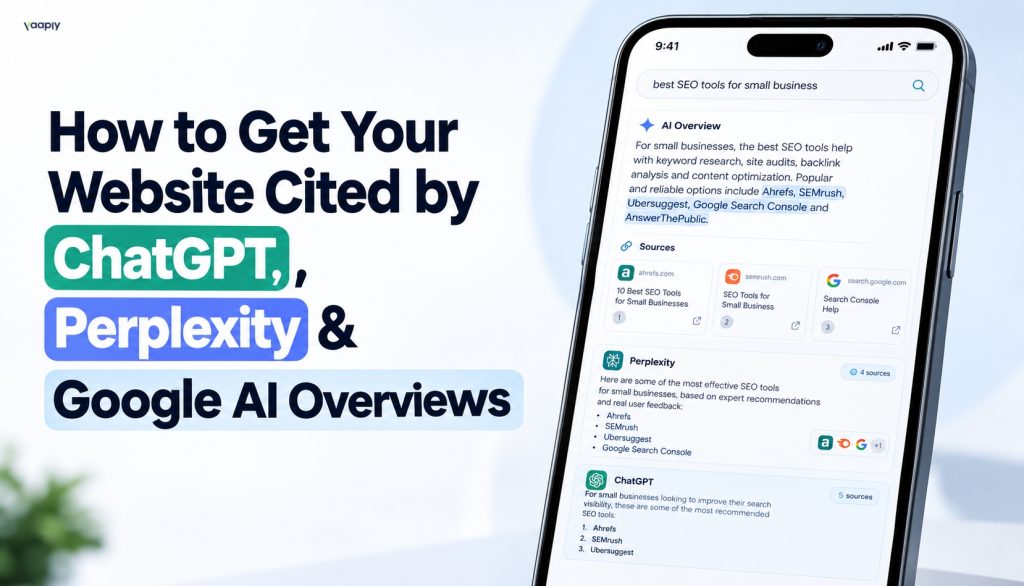
Quick answer: how to get cited by ai search engines like ChatGPT, Perplexity & Google AI Overviews comes down to five things working together: content that directly answers one specific question, structure an AI system can lift as a clean passage, entity signals that establish who you are, third-party mentions that back up that authority, and content that stays current enough for the engines to keep trusting it. None of these alone is enough. Ahrefs’ own crawl data suggests that a large share of the pages an AI engine retrieves while researching an answer never make it into the final response. Getting fetched and getting chosen are two different problems, and this guide is about solving the second one.
A Citation Is Not the Same Thing as a Mention
Before you optimize for anything, get the vocabulary straight, because it changes what you’re actually building toward.
- A mention is when an AI answer names your brand in the text. The model learned about you from someone else’s page.
- A citation is when your own page is linked as the source: the footnote, the source chip, the link card next to a Google AI Overview.
- A recommendation goes further and puts you forward as the answer to the user’s question, not just a supporting reference.
You can be mentioned without ever being cited, and you can be cited on a page where your brand isn’t even named. Your data is just backing up someone else’s claim. Each of these tells you something different about where you actually stand, so before you chase “AI visibility” as a vague goal, decide which of the three you’re actually trying to win.
How ChatGPT Actually Chooses What to Cite

ChatGPT leans on two separate systems: its training data for general knowledge, and live web search when a question needs current information. The single most actionable fact in that second half is that ChatGPT’s web search runs on Bing’s index. If your site isn’t indexed properly in Bing, ChatGPT’s live search has nothing to find, no matter how well you rank on Google. Submitting and verifying your site in Bing Webmaster Tools is a five-minute task that most teams skip entirely because their whole SEO workflow has been built around Google Search Console.
How Perplexity Actually Chooses What to Cite
Perplexity behaves more like a real-time research assistant than a search engine. It needs technical access first. PerplexityBot has to be allowed in your robots.txt, or none of the rest matters. Beyond access, Perplexity ranks sources by how cleanly it can pull a passage out of the page and by how recently that page was updated; it weights freshness more heavily than a typical Google ranking would. Perplexity also tends to cite between five and fifteen sources per answer, which is more real estate than a single AI Overview offers, meaning there’s more room to earn a spot if the content is structured to be lifted in one clean piece.
How Google AI Overviews Actually Choose What to Cite
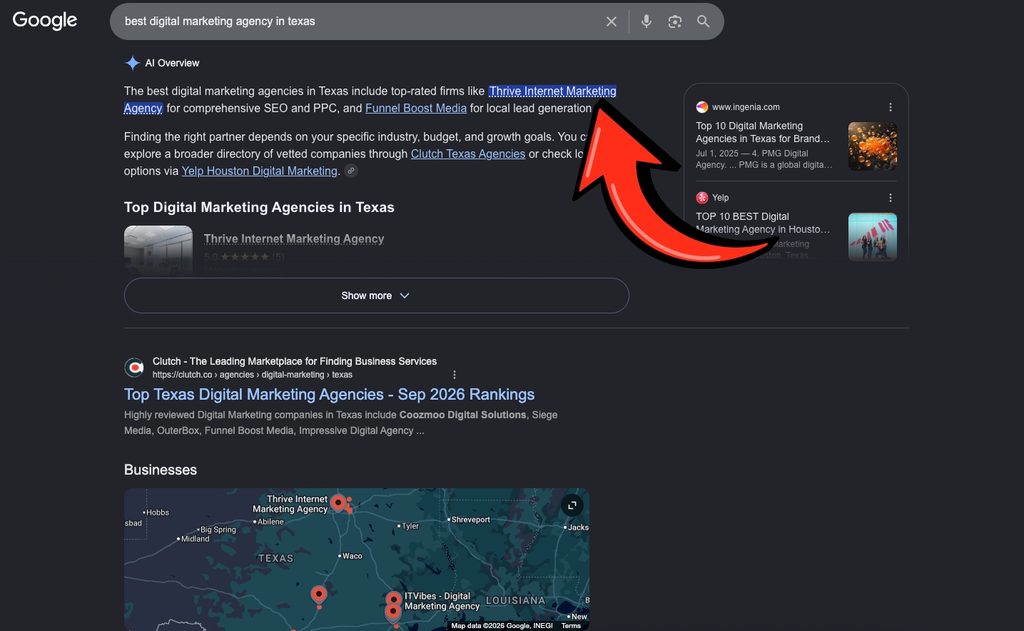
This is the part most SEO teams get wrong: ranking on page one is not a prerequisite for being cited in an AI Overview. A BrightEdge analysis found that only a small share of AI Overview citations, roughly one in six, also appear in the traditional top 10 organic results for that same query. The other five out of six come from somewhere else entirely: pages with strong structured data, clear entity definition, and content that answers the exact phrasing of the query, even if that page wouldn’t win a conventional ranking battle on its own.
The Five-Part Framework
1. Content Authority
Named authorship, visible credentials, and content that goes deeper than a surface-level summary. If the top-ranking pages on your target topic are short and generic, matching their depth won’t earn a citation. You need to go further than what’s already out there.
2. Structural Clarity
Lead with the answer, not the setup. No “in this article we’ll explore.” The model should be able to lift your first sentence and use it as the answer on its own.
3. Entity Signals
Schema markup (Organization, Person, Article, FAQPage) tells an AI system unambiguously who is publishing this and who they are. The more consistently your brand name, description, and logo appear the same way across the web, the easier it is for a model to resolve “who is this” with confidence.
4. Cross-Platform Third-Party Mentions
This is the piece most content teams underweight because it isn’t something you control directly on your own page. AI engines build confidence in a brand the same way a person does: by seeing it referenced independently, in places that aren’t the brand’s own website. Editorial mentions, digital PR placements, and listicle inclusions on sites the AI models already trust do double duty: they build the entity confidence models use to decide who’s worth citing, and they compound over time as the model “learns” your brand as an authority on the topic.
5. Freshness
A page that was accurate eighteen months ago and hasn’t been touched since sends a quiet signal that it might not reflect the current state of things. Update dates, current data points, and a visible “last updated” stamp all help.
The Step-by-Step Process
- Pick your priority engines. ChatGPT, Perplexity, and Google AI Overviews don’t behave identically. Decide which one your buyers actually use before optimizing for all three at once.
- Audit technical access. Confirm PerplexityBot and other AI crawlers aren’t blocked in robots.txt, and confirm your site is indexed in Bing, not just Google.
- Rewrite your priority pages to lead with the answer. One direct sentence, then supporting detail below it.
- Add structured data. FAQPage, Organization, and Article schema, at minimum.
- Build entity consistency. Same name, same description, same logo, everywhere your brand appears online.
- Earn third-party mentions on sites the AI engines already treat as trustworthy sources. This is where editorial link building and digital PR do their real work.
- Set a refresh cadence. Treat your highest-value pages as living documents, not one-and-done publications.
Common Mistakes That Keep Sites Out of AI Answers
- Burying the actual answer under two paragraphs of preamble
- Blocking AI crawlers unintentionally through overly broad bot-blocking rules
- Optimizing only for Google while ignoring Bing indexing, which quietly cuts ChatGPT out of the picture
- Publishing once and never updating, even on topics that shift monthly
- Chasing keyword density instead of writing a sentence a model could actually quote
How to Track Whether You’re Actually Being Cited
Pick your real, priority questions (the ones your buyers actually type) and run them through each engine on a recurring schedule. Log whether you were cited, in what position, and which exact passage got pulled. Do this per engine, because they disagree with each other, and do it on a schedule, because the surfaces move; a page cited this month can quietly drop out next month after a model refresh. An AI search visibility tracking tool can automate this log instead of running it manually query by query.
FAQ
What is the difference between an AI citation and a brand mention?
A brand mention is your name appearing in the answer text. An AI citation is your actual page being linked as the source. You can get one without the other.
Does ChatGPT use Google’s search index?
No. ChatGPT’s live web search runs on Bing’s index, so being indexed and verified in Bing matters even if your SEO workflow has historically centered on Google.
How long does it take to start getting cited after publishing new content?
Most teams see a lag of several weeks between publishing optimized content and appearing consistently in AI answers, since models need time to crawl, index, and build confidence in a new or updated page.
Do backlinks still matter for AI citations?
Yes. Backlinks and editorial mentions are one of the strongest entity-authority signals AI engines use to decide which brands are worth citing, on top of the on-page structure work.
Can a small business compete for AI citations against a bigger brand?
Yes, more easily than in traditional rankings, because AI Overview citations don’t require a top-10 organic ranking. A page with clear structure, entity signals, and third-party backing can out-cite a larger competitor’s weaker page.
Does content need to be brand new to get cited, or can existing pages be optimized?
Existing pages can absolutely be optimized. Refreshing structure, adding schema, and updating stale data is often faster than starting from scratch.
The on-page framework above only gets you halfway. The entity-authority piece still depends on being mentioned on sites AI models already trust. That’s the specific gap Yaaply’s editorial link building and digital PR work is built to close. Get in touch if that’s the piece you’re missing.