
Last updated: October 2026.
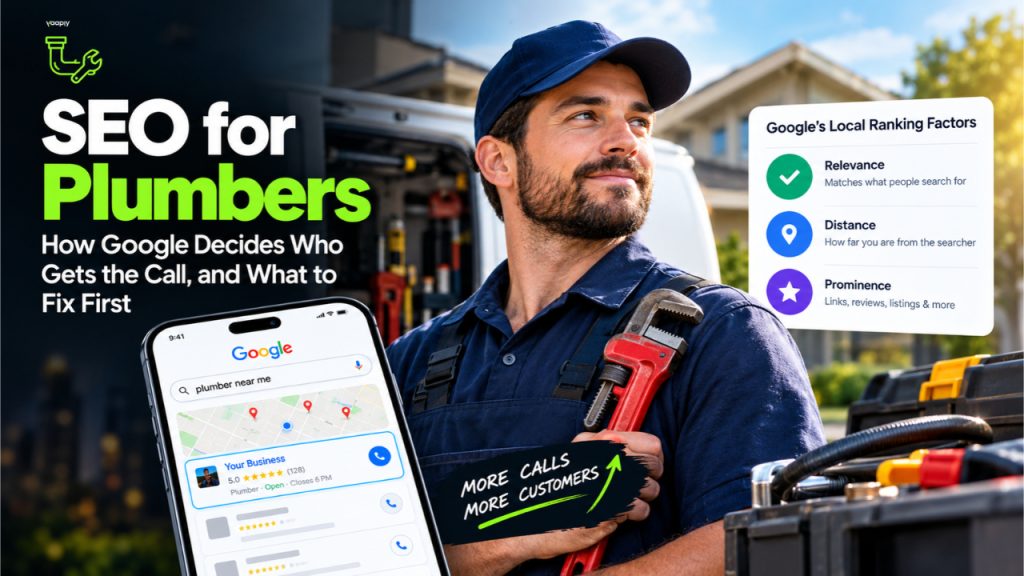
SEO for plumbers means working on the three things Google says it uses for local results: relevance, distance, and prominence. You can’t control distance, so start with relevance (a complete Business Profile and clear service pages), then build prominence with reviews, listings, and local links.
Quick Takeaways
- Google’s own help page says local results are based mainly on relevance, distance, and prominence, and it lists links, articles, directories, and reviews as inputs to prominence.
- Fix relevance first. It is the cheapest part and the one you fully control.
- Ask for reviews after every job, but never reward them. Google treats rewarded reviews as fake engagement.
- Only one of the three top-ranking guides we read covers link building in any detail, and its ideas are generic. That is the biggest open gap for most plumbers.
- A 30-day plan is at the bottom, in the order we would do it.
How does Google rank plumbers in local search?
Google ranks local results using relevance, distance, and prominence, according to its Business Profile help page. It does not say how much each one weighs.
| Factor | What Google says it means | What a plumber can do about it |
| Relevance | How well a profile matches what someone searched for. Complete, detailed business information helps. | Fill in every profile field. Build one page per service. |
| Distance | How far each result is from the location in the search, or from the searcher if no location is given. | Very little. Do not fake an address. |
| Prominence | What Google knows about a business from across the web, including links, articles, and directories. Review count and score count, and so does your position in regular web results. | Reviews, consistent listings, local links, and a solid website. |
Here is our view. In most towns, a handful of plumbers are equally relevant and sit at similar distances from the searcher. That leaves prominence as the factor you can actually move, and it is the one most plumber guides cover the least.
What do the top-ranking guides disagree on?
We read the three guides currently ranking for this topic (SEO Ninja, Plerdy, and Signpost) on October 29, 2026. Where they give numbers, the numbers conflict, and none of them names a source.
| Question | SEO Ninja | Signpost | Plerdy (2023) |
| Share of searches on mobile | More than 70 percent of local service searches | Over 60 percent of plumbing searches | No figure |
| Time to results | Rankings move in 90 to 120 days, leads grow in months 4 to 6 | 3 to 6 months | No figure |
| Reviews needed | Gives an example of 200 reviews beating 20 | 40 to 80 in most competitive areas | No figure |
| Link building | One mention in an FAQ, no how-to | Not covered | Generic list (local sponsorships, directories, content) |
Google publishes none of these numbers. Treat every figure above as a rough guide from a vendor, not a rule. The better test is to look at the three plumbers in your own map results and see what they have.
Step 1: Set up your Business Profile the way Google expects
Claim and verify your profile first, because Google’s help page says verification tells Google you are allowed to represent the business. Then set your primary category to Plumber, which both SEO Ninja and Signpost recommend.
Two rules trip up plumbers more than any others:
- Hide your address if you don’t serve customers there. Google’s guidelines say a service-area business should hide its address and show a service area instead.
- Set your service area by city, postal code, or similar area. Google no longer lets you set it as a distance around your business.
Google’s guidelines also tell you to reflect your business accurately. That is the reason to avoid stuffing words like “Best 24 Hour Plumber” into your business name. Use the name on your van and invoices.
Step 2: Fill in everything that tells Google what you do
Google says complete and detailed information helps it match your profile to the right searches, so leave no field blank. Add each service you offer with a short description, your real hours, and any emergency availability. Use a local phone number your office answers. Upload photos of your trucks, your techs, and finished jobs.
This takes an afternoon and it is the single cheapest improvement on this page.
Step 3: Build one page per core service
Each service gets its own page. Drain cleaning, water heater repair, water heater replacement, sewer line repair, leak detection, and repiping are separate searches, and one “services” page cannot answer all of them.
A strong service page includes:
- What the job involves and when to call
- How you price it (flat rate, trip fee, or estimate) without giving fake exact numbers
- Photos from your own jobs
- Three to five real questions customers ask
- A click-to-call button near the top
Put the service and your main city in the title tag. Google lists your position in regular web results as part of prominence, so these pages feed your map ranking too.
Step 4: Add city pages only where you have real work to show
Add a page for a city only if you have worked there and have something real to say about it. Google’s spam policies call out doorway abuse: pages made to rank for similar searches that lead people to a less useful page. Fifteen near-identical pages with the city name swapped is exactly that pattern.
A fair test: if you removed the city name, would the page still be useful? To pass, include:
- Real jobs in that city, with photos
- Plumbing problems common to that area, such as older pipes or hard water
- Reviews from customers in that city
- Your honest response time to that area
Signpost suggests 400 words per city page. Google gives no minimum, so write what the page needs and stop.
Also be realistic about the map. Google defines distance as how far a result is from the searched location, and a web page cannot change how far your shop is from the searcher. City pages mainly help your website show up in regular results for that city.
Step 5: Get reviews the way Google allows
Google says review count and review score factor into local ranking, so asking for reviews is part of the job. Send a text with a direct review link within a few hours of finishing the work. Reply to every review, good or bad.
Where plumbers get hurt is rewards. Google’s help page says offering free or discounted goods or services to get reviews posted, changed, or removed is fake engagement and is strictly prohibited. Google’s transparency report says profiles that repeatedly break the rule can be restricted.
One more caution. PPC Land reported an April 2026 update that also bars merchants from asking staff to collect a set number of reviews. If you pay technicians per review, check Google’s current policy before you keep doing it.
Google gives no review target. Count the reviews on the top three plumbers in your map results and plan to match them within a year.
Step 6: Clean up your listings
Google names directories as part of prominence, so your business name, address, and phone number should match everywhere. Start with the places customers and Google use most: Yelp, Angi, Bing Places, Apple Maps, the Better Business Bureau, and your local chamber of commerce.
Signpost suggests building 50 to 75 listings. It gives no source for that, and our view is that ten accurate listings beat fifty sloppy ones. Fix wrong or duplicate listings before you add new ones.
Step 7: Earn local links (the step most guides skip)
Google says prominence draws on links and articles from across the web, yet most plumber guides barely mention links. This is where a plumber with a decent profile can pull ahead of one with a decent profile and nothing else.
A rule first. Google’s spam policy lists buying or selling links for ranking purposes as link spam, including trading money, goods, or services for links. The same page says buying and selling links is a normal part of the web for advertising and sponsorship. In plain terms: earn links or sponsor openly, and stay away from link marketplaces.
Good local link ideas for a plumber:
- Local sponsorships (youth teams, school events, charity runs) where the organizer lists sponsors on its site
- Installer or “find a pro” pages from the brands you install
- Your chamber of commerce and trade association member pages
- Local news, when you can give a real expert comment on frozen pipes, boil notices, or storm damage
- Partner pages from realtors, home inspectors, and property managers who send you work
Our view is that relevance beats raw authority here. A link from your town’s chamber or a home inspector’s site tells Google more about a plumber in that town than a high-authority page on an unrelated topic.
Step 8: Fix the site basics and add LocalBusiness schema
Make sure your site loads fast on a phone, uses HTTPS, and has a tap-to-call button on every page. Then add LocalBusiness structured data. Google’s documentation says you can add it to any page, though it makes most sense on a page with your business information, and you should check it with the Rich Results Test.
Keep the hours and phone number in your markup identical to your Business Profile. That is common practice, not a Google rule, but mismatches look sloppy and are easy to avoid.
Step 9: Track calls, not just rankings
Rankings are a means to an end. Track the things that pay you:
- Calls and direction requests from your Business Profile performance screen
- Impressions and clicks per page in Google Search Console
- A tracking phone number on your website, so you know which calls came from search
- A simple log of how each new customer found you, kept for 30 days
Rank checkers show different results depending on where they check from, so test from a few neighborhoods instead of one.
What should you do first? A 30-day plan
| Week | Focus | Done when |
| 1 | Business Profile (steps 1 and 2) | Verified, address handled correctly, every field filled, photos added |
| 2 | Service pages (step 3) | Each core service has its own page with real photos |
| 3 | Reviews and listings (steps 5 and 6) | Review text goes out after every job, listings match |
| 4 | Links, schema, tracking (steps 7 to 9) | Three local link targets contacted, schema live, call tracking on |
City pages (step 4) come after day 30, once the foundation is in place.
Should you do SEO for plumbers yourself or hire help?
You can do most of the first three weeks yourself. Bring in help when the work needs steady time or specialist skill.
| Task | Owner or office manager can do | Bring in help when |
| Business Profile and listings | Yes | You have multiple locations or a suspended profile |
| Review requests | Yes | You want it automated across the crew |
| Service and city pages | Yes, if you can write well | You have no one with time to write them |
| Local link building | Sometimes | Outreach keeps stalling |
| Schema and technical fixes | Rarely | Almost always |
On cost, SEO Ninja’s page states $750 to $3,000 a month for agency work but gives no source, so treat it as a rough range. Whoever you talk to, ask for the scope in writing and ask how they will report calls, not just rankings. Be wary of anyone who guarantees a page-one ranking, because no one controls Google’s results.
What SEO mistakes do plumbers make most often?
- Showing a home address on a service-area profile instead of hiding it
- Offering discounts or gifts for reviews
- Publishing near-identical city pages with only the city name changed
- Using different business names or phone numbers across listings
- Buying links from marketplaces instead of earning them
- Watching rankings and ignoring phone calls
FAQ
How long does SEO for plumbers take?
Google gives no timeline. Vendor guides we read say roughly 90 days to 6 months, but that depends on your market and how much your competitors have already done. Business Profile fixes can show effects sooner than links and page work.
How much does SEO for plumbers cost?
It depends on scope. One agency guide states $750 to $3,000 per month without a source. Doing steps 1 to 6 yourself costs time and little else. Ask any provider for an itemized scope before you sign.
How many reviews does a plumber need to rank?
Google does not publish a number. It says review count and score both factor in. Compare yourself to the top three plumbers in your own map results and aim to match them.
Can I do SEO for plumbers myself?
Yes for the foundation: your Business Profile, service pages, review requests, and listings. Technical fixes and steady link building are where most owners eventually want help.
Is buying backlinks safe for a plumbing website?
Not if the goal is ranking. Google’s spam policy lists buying or selling links for ranking purposes as link spam. Sponsorships and ads are a normal part of the web, so sponsor openly and earn the rest.
Should a plumber hide their address on Google?
If you don’t serve customers at your address, yes. Google’s guidelines say a service-area business should hide its address and list a service area by city or postal code instead.
Yaaply builds editorial backlinks for businesses that want authority from relevant sites, never from link marketplaces. If your plumbing site is ready for step 7, see our services: [Yaaply services URL].
Sources
Checked on October 29, 2026.
- How to improve your local ranking on Google, Google Business Profile Help
- Guidelines for representing your business on Google, Google Business Profile Help
- Manage service areas for your business, Google Business Profile Help
- Reviews guidance and fake engagement, Google Business Profile Help
- Spam policies for Google web search, Google Search Central
- Local business (LocalBusiness) structured data, Google Search Central
- Maps content protections, Google Transparency Report
- Google tightens Maps review policy, PPC Land (secondary source, verify on Google’s policy page)
- Local SEO for Plumbers, SEO Ninja
- SEO for Plumbers: The Complete Guide, Plerdy
- How to Improve Local SEO for Plumbers, Signpost