
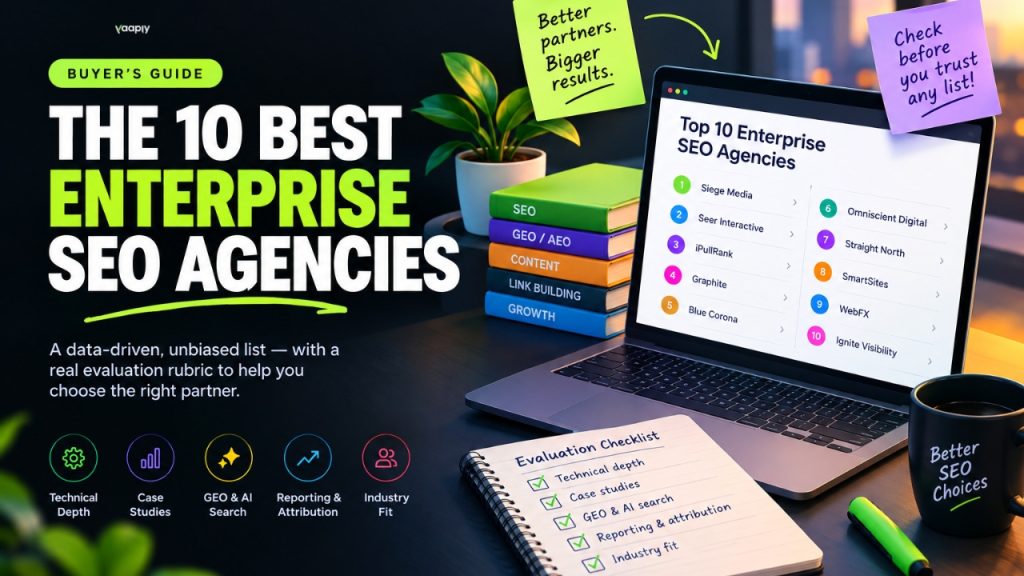
Best enterprise SEO agency lists have a quiet problem: most of them are written by an agency, and that agency almost always ranks itself first. We checked. It’s worth knowing before you trust any list like this one, including this one, which is why we’re not on it.
A quick note before the list
Look at the “best enterprise SEO agency” lists currently ranking. Several are published by an agency that puts its own name at or near the top. That’s not necessarily dishonest, but it’s not a neutral buyer’s guide either. When you’re evaluating any list like this, check who published it and whether they included themselves before you check anything else on the page.
This list doesn’t include Yaaply, since we’re not an enterprise SEO agency, we’re a link building and AI citation specialist that enterprise SEO teams and agencies bring in for a specific piece of the work. That’s disclosed once, at the end, and nowhere else in the list below.
How we evaluated these agencies
Rather than generic “look into scalability” advice, here’s the actual rubric worth applying to any enterprise SEO agency you’re considering:
- Technical depth on complex sites. Can they handle multi-domain architecture, JavaScript rendering, and international/multilingual setups, not just a single WordPress blog.
- Real, verifiable case studies. Specific numbers, specific clients (named or clearly described), not just “we grew traffic.”
- GEO and AI search capability. A dedicated, demonstrable approach to LLM citation and AI Overview visibility, not GEO as a buzzword bolted onto an SEO page.
- Reporting and attribution. Can they tie organic work to pipeline or revenue, not just rankings and sessions.
- Fit for your industry and scale. An agency great for SaaS may be the wrong pick for e-commerce or a regulated industry like healthcare or finance.
Score any agency you’re considering against these five before you look at logos or client lists.
The 10 Best Enterprise SEO Agencies
1. Siege Media
Core Strength: Full-service SEO paired with a genuine generative engine optimization (GEO) practice, not GEO as an add-on. Why Choose Them: They run content strategy, technical SEO, and digital PR under one roof, with proprietary tools for keyword targeting and content performance tracking. What Makes It Different: Their GEO work is built into the core offering rather than a separate upsell, with published case studies showing measurable AI citation volume, not just traditional ranking gains. Pros:
- Broad service coverage (SEO, GEO, content, digital PR) under one contract
- Multiple U.S. offices, useful for enterprise procurement that prefers a domestic vendor Cons:
- Broad scope means less specialization than a firm focused on one lane like technical SEO or link building alone
- Best fit skews toward mid-to-large B2B, fintech, and e-commerce; less proven in regulated industries like healthcare
2. Seer Interactive
Core Strength: Data infrastructure and analytics maturity applied directly to enterprise SEO decision-making. Why Choose Them: Strong fit for enterprises that already have significant data operations and want an agency that can plug into that infrastructure rather than working around it. What Makes It Different: Their SEO recommendations are built on proprietary data tooling rather than standard third-party SEO software alone, which matters for enterprises with unusual site structures or data requirements. Pros:
- Deep bench across SEO, paid media, and CRO, useful if you want fewer vendors
- Strong track record with healthcare and finance, industries with real compliance constraints Cons:
- Data-heavy approach may be overkill or a poor fit for smaller enterprise teams without mature analytics
- Fewer third-party reviews than some competitors, which limits independent benchmarking
3. iPullRank
Core Strength: Technical SEO on genuinely complex, large-scale site architectures. Why Choose Them: If your core problem is crawl budget, JavaScript rendering, or a site with millions of pages, this is the specialist lane, not a generalist content shop. What Makes It Different: Their relevance engineering framework treats technical SEO and AI-era content relevance as one connected problem rather than two separate workstreams. Pros:
- Genuine technical specialization, useful when other agencies keep recommending “more content” as the fix
- Strong enterprise client roster (Ralph Lauren, LG, American Express class of brand) Cons:
- Less of a fit if your primary gap is content production or link building rather than technical architecture
- Smaller team than some full-service alternatives, which can mean less bandwidth for multiple simultaneous workstreams
4. Graphite
Core Strength: AI-native, programmatic content production at genuine enterprise scale. Why Choose Them: Built for companies that need hundreds or thousands of pages produced and optimized systematically, not agencies still doing one-off blog posts. What Makes It Different: Their proprietary topical SEO tooling is built to produce single pieces of content that rank for large keyword clusters at once, which matters when content velocity is the actual bottleneck. Pros:
- Strong fit for product-led SaaS and consumer tech with large content surface areas
- AEO/AI-search capability built into the core process, not bolted on Cons:
- Less differentiated for a smaller enterprise site that doesn’t need programmatic scale
- Newer proprietary tooling means less long-term track record than older agencies on this list
5. Terakeet
Core Strength: Brand reputation and narrative control across both traditional and AI-driven search. Why Choose Them: A genuinely different specialization from the rest of this list, useful specifically when the problem is how a brand is perceived or misrepresented in search and AI answers, not just ranking position. What Makes It Different: They combine brand risk detection with organic search work, which matters for enterprises in regulated or reputation-sensitive industries. Pros:
- Rare specialization in reputation management combined with SEO, hard to find elsewhere on this list
- Strong fit for insurance, pharma, and other industries where public perception carries real financial risk Cons:
- Narrower fit if your need is pure technical SEO or content velocity rather than reputation work
- Positioning and pricing likely skew toward larger enterprise budgets given the specialization
6. Directive Consulting
Core Strength: SEO tied explicitly to pipeline and revenue outcomes for tech and B2B companies. Why Choose Them: Built for organizations where the CMO or CFO wants a direct line from organic investment to booked revenue, not just traffic and ranking reports. What Makes It Different: Their approach ties SEO, paid media, and RevOps together under one attribution model, rather than treating SEO as an isolated channel. Pros:
- Enterprise client roster spanning Amazon, Adobe, and Zoominfo suggests real capacity at scale
- Attribution-first approach appeals to finance-scrutinized marketing budgets Cons:
- Full-funnel, multi-channel approach may be more than needed if you only want organic search work
- Revenue-attribution focus works best when your sales cycle and CRM data are already clean; messier internal data will slow this down
7. uSERP
Core Strength: Enterprise-scale link building and E-E-A-T signal development. Why Choose Them: A specialist pick when the actual gap is authority and trust signals, not content volume or technical fixes. What Makes It Different: Their outreach targets sites that are themselves visible in AI search, which connects traditional link building directly to AI citation potential rather than treating them as separate goals. Pros:
- Strong SaaS and fintech client roster (monday.com, Robinhood, CrowdStrike)
- Clear specialization makes it easy to slot in alongside an existing content or technical SEO vendor Cons:
- Not a fit if you need a single vendor for full-service SEO, this is a specialist add-on, not a generalist replacement
- Effectiveness depends heavily on your existing content already being link-worthy; won’t fix a weak content foundation
8. Titan Growth
Core Strength: Proprietary crawl technology for enterprise-scale technical diagnostics. Why Choose Them: Useful when you need to see your site the way search engines actually crawl it, not just a standard third-party audit tool’s approximation. What Makes It Different: Their in-house crawler (TitanBOT) is built specifically to emulate search engine crawling behavior, which can surface issues generic SEO tools miss on unusually large or complex sites. Pros:
- Broad service range beyond SEO (paid media, Amazon marketing) useful for enterprises wanting fewer vendors
- Strong fit for e-commerce and hospitality with complex, high-SKU sites Cons:
- Breadth of services (paid, social, Amazon) may dilute focus compared to an SEO-only specialist
- Less publicly documented GEO/AI search capability than several others on this list
9. Higher Visibility
Core Strength: Enterprise e-commerce SEO at scale. Why Choose Them: A strong fit specifically for large e-commerce catalogs, franchise networks, and industries like automotive and financial services with high page-count sites. What Makes It Different: Their reporting centers on regular, structured performance reviews rather than a one-time audit-and-report model, which matters for enterprise stakeholders who need ongoing visibility. Pros:
- Deep e-commerce and franchise experience across automotive, legal, and home builder verticals
- Structured, recurring reporting cadence suits enterprise stakeholder expectations Cons:
- Less specialized in pure B2B SaaS or highly technical enterprise environments
- Broad service list (PPC, web design, link building) means SEO is one of several priorities, not the sole focus
10. Growth Plays
Core Strength: Revenue-attributed SEO built specifically for B2B SaaS and developer tools companies. Why Choose Them: A tight, specific fit if your enterprise is B2B SaaS or venture-backed, rather than a generalist agency trying to serve every industry at once. What Makes It Different: Every piece of content is measured against bottom-line impact individually, and their AI SEO practice is built into the core offering rather than treated as a separate line item. Pros:
- Strong, specific client roster in B2B SaaS (Lattice, Calendly, Merge)
- Automated error monitoring built into their process catches technical issues before they compound Cons:
- Narrow industry focus means a poor fit for enterprises outside B2B SaaS and dev tools
- Smaller, more specialized team than the broader full-service agencies on this list
Choosing between them
If your biggest constraint is technical complexity, iPullRank or Titan Growth. If it’s content velocity at scale, Graphite. If it’s tying organic to revenue for a finance-scrutinized budget, Directive Consulting or Growth Plays. If the real gap is authority and AI citation signals rather than any of the above, that’s a narrower problem, and one worth solving separately from picking a full-service agency.
None of the agencies above are the right fit if your actual need is local, not enterprise-wide. A multi-location business optimizing for city-level search and Google Business Profile visibility should be looking at the best local SEO agencies instead, that’s a different specialization with a different evaluation criteria entirely.