
AI search optimization tools now matter as much as traditional SEO software, because getting your content cited inside ChatGPT, Perplexity, Google AI Mode, and Gemini answers requires a different kind of optimization than simply ranking on page one of Google. Every tool on this list was chosen independently. Yaaply does not sell any of the tools below and has no affiliate relationship with any of them, so nothing here is ordered by a partnership or by an interest in pushing one product over another.
We also kept this list tight on purpose. Every entry genuinely helps optimize content for AI citation and search visibility. None of them are general SEO platforms, cold email outreach tools, link building CRMs, page indexing tools, or general purpose AI assistants with an SEO feature bolted on as an afterthought. If a tool didn’t earn its place on real optimization capability, it isn’t here.
One more distinction worth making early. This post covers tools that help you do the optimization work needed to become citable by AI systems, not tools that measure whether that work is paying off. If you’re looking for AI visibility tracking and monitoring platforms instead, that’s a separate category, and we cover it in our other post on the best AI search visibility tracking tools.
What are AI search optimization tools?
AI search optimization tools are software platforms that help writers and SEO teams shape content so it performs well in both traditional search rankings and AI generated answers. Most combine some mix of SERP analysis, topic and entity coverage scoring, keyword clustering, and increasingly, direct feedback on how likely a page is to get pulled into an AI Overview, a ChatGPT response, or a Perplexity citation. The best of them feel less like a checklist and more like an editor sitting next to you while you write, showing you what’s missing compared to what’s already getting cited.
1. Surfer SEO

Core Strength: Surfer SEO’s real time Content Score editor scores your draft against top ranking pages using more than 500 web signals as you write, and it now includes built in AI visibility tracking across ChatGPT, Perplexity, Google AI Mode, and Gemini rather than treating that as a separate purchase.
Pricing: Verified live on surferseo.com, plans start at Discovery for $49 per month with 120 documents, moving up to Standard at $99 per month with AI visibility tracking and 25 weekly AI prompts tracked, Pro at $182 per month with 50 prompts tracked daily across 5 brand workspaces, Peace of Mind at $299 per month with unlimited documents and 100 prompts tracked daily, and a custom Enterprise tier at $999 per month. All figures reflect yearly billing, and monthly billing runs noticeably higher.
Best Suited For: Content teams and agencies publishing frequently who want a live scoring editor guiding them as they write, not just a one time report handed back after the fact.
Pros:
• Deepest real time content scoring feedback loop in the category
• AI visibility tracking built directly into the platform instead of sold separately
• Backed by more than 150,000 customers and a 4.8 out of 5 rating on G2 across 500-plus reviews
Cons:
• Pricing climbs quickly once AI visibility tracking is needed at scale
• Document credits do not roll over on monthly plans
• Not a full SEO suite, so there is no backlink or technical crawl data included
2. Clearscope
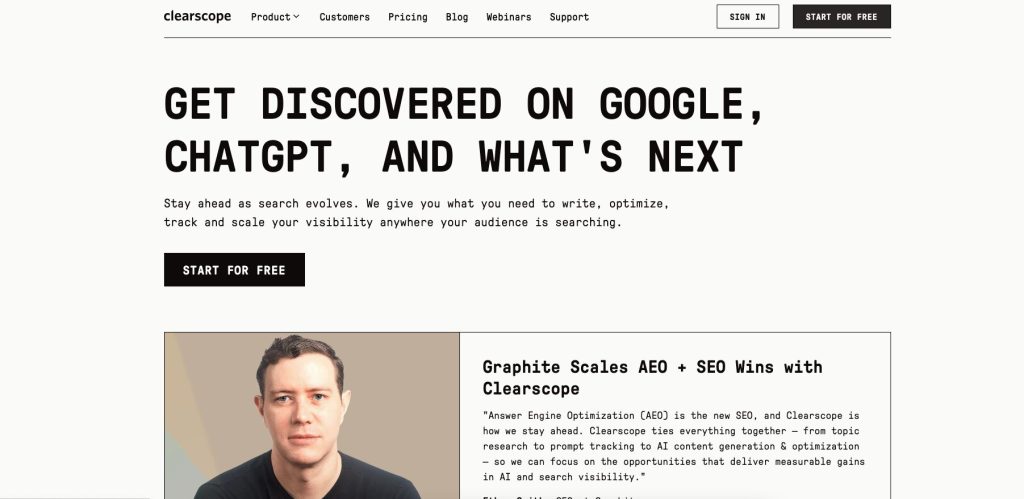
Core Strength: Clearscope grades drafts from A++ down to F based on topic coverage compared to top ranking competitors, built around a clean interface that non-SEO writers can use on their own, and it has recently expanded into AI answer citation tracking.
Pricing: Essentials runs $129 per month with 20 AI Drafts, 20 Topic Explorations, a 50-page Content Inventory, and unlimited users and projects. Business runs $399 per month with a 300-plus page Content Inventory and a dedicated account manager. Enterprise pricing is custom.
Best Suited For: Agencies and teams with writers who aren’t SEO specialists and need a simple, high-trust grading layer before publishing.
Pros:
• Extremely easy for non-technical writers to use independently
• No per-seat pricing, with unlimited users on every plan
• Strong readability scoring
Cons:
• No free tier available
• The most expensive entry point among the AI content tools on this list
• Draft caps stay flat between Essentials and Business despite the price jump
3. Frase
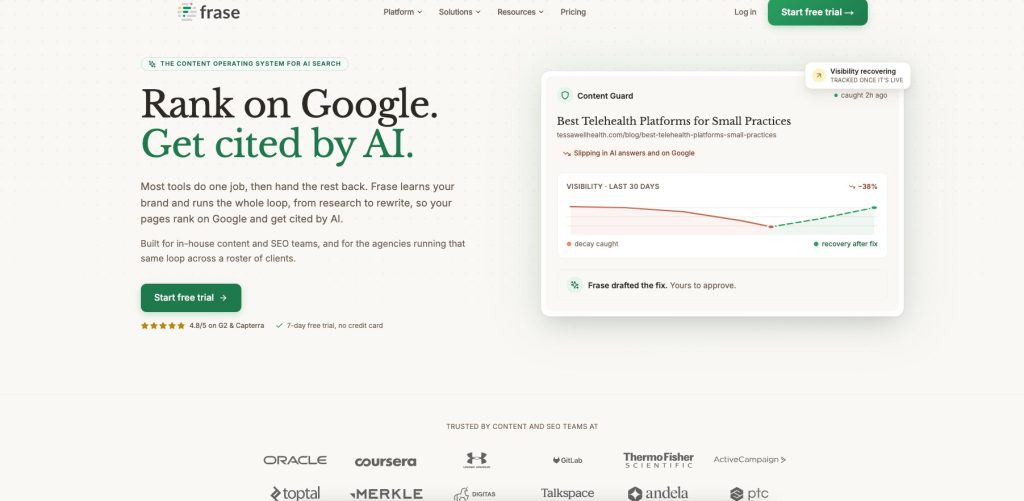
Core Strength: Frase combines SERP analysis, keyword clustering, AI generated content briefs, and dual SEO and GEO scoring, with AI visibility tracking built into the editor from the entry-level plan up.
Pricing: Reported figures vary by source, but the most consistently cited current structure is Basic at $49 per month, Team at $129 per month, and Enterprise at $299 per month, with a 7-day free trial. Exact entry pricing is worth confirming directly on Frase’s site, since it’s the least consistent pricing of the AI content tools on this list.
Best Suited For: Startups, solo writers, and lean marketing teams that want strong content briefs and AI visibility tracking without paying premium prices.
Pros:
• Fastest learning curve in the category
• GEO and AI visibility tracking included even on lower tiers
• Strong SERP-based outline generation
Cons:
• Keyword recommendations are generally considered less precise than Surfer or Clearscope
• AI generated content typically needs substantial editing
• Pricing reporting is inconsistent across sources, so it’s worth verifying before buying
4. MarketMuse
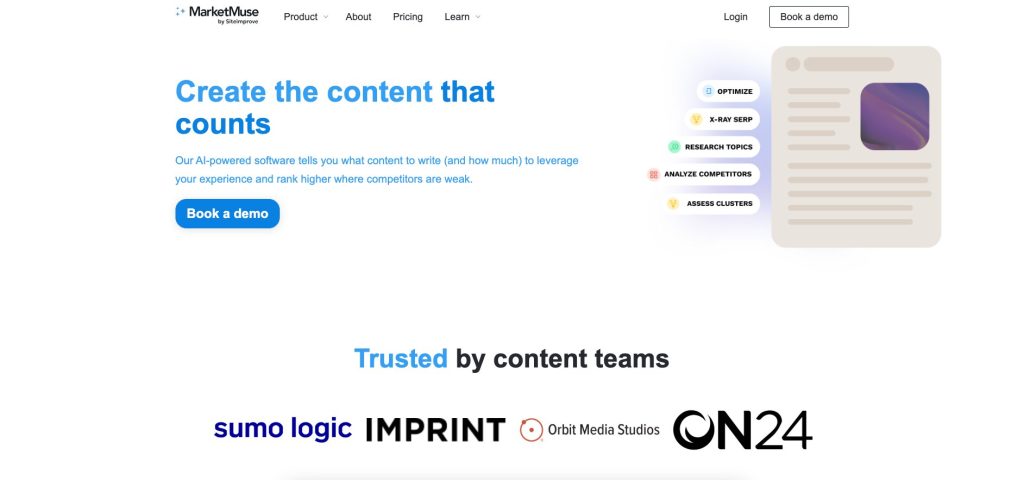
Core Strength: MarketMuse uses proprietary AI topic modeling built for strategic content planning and topical authority mapping across an entire site, rather than scoring individual articles one at a time.
Pricing: There is no reliable current public self-serve pricing. It is effectively an enterprise or custom quote-based tool, so budgeting requires a sales conversation rather than a published price sheet.
Best Suited For: Agencies and enterprise teams planning content at the site-inventory level, not teams that just want per-article optimization scores.
Pros:
• Unmatched depth for large scale topic and content gap planning
• Patented difficulty scoring methodology
• Best fit when there are dedicated SEO strategists on hand to interpret the data
Cons:
• Opaque pricing makes budgeting difficult
• Doesn’t optimize individual articles the way Surfer or Clearscope does
• Overkill for small teams or solo operators
5. Semrush On-Page SEO Checker
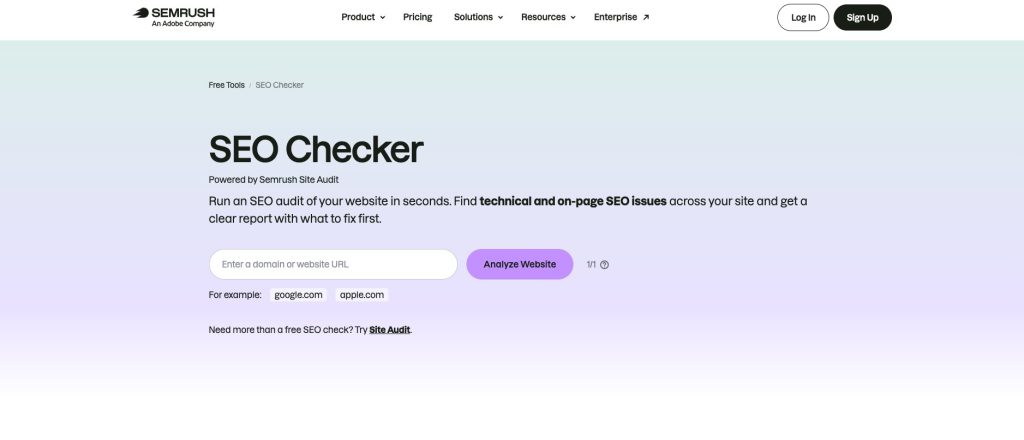
Core Strength: This is a module inside the broader Semrush platform that compares your page against real-time top-10 competitors and pulls strategy, backlink, technical, and semantic content ideas into one report.
Pricing: Not sold standalone. It requires a Semrush subscription starting around $117 to $140 per month depending on billing terms and current promotions, with the on-page checker included as part of the broader suite.
Best Suited For: Agencies and teams that already use or are considering Semrush for keyword research and competitor tracking and want on-page checks bundled into the same login.
Pros:
• Single login covers on-page ideas, technical issues, and backlink opportunities together
• Real-time top-10 competitor comparison
• Strong brand trust and support infrastructure
Cons:
• Not purchasable on its own, a poor fit if on-page checking is the only need
• Content optimization depth is generally considered less specialized than dedicated tools like Surfer or Clearscope
6. Yoast SEO
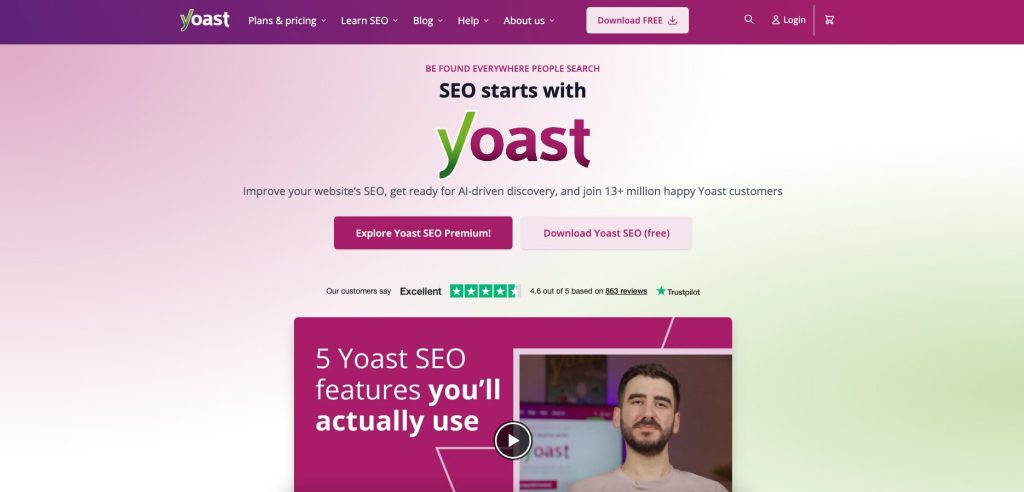
Core Strength: Yoast SEO is the most recognized WordPress SEO plugin, handling on-page meta tags, readability analysis, XML sitemaps, and basic schema directly inside the WordPress editor.
Pricing: A free version is available. Premium runs roughly $99 to $129 per year per site, varying by source and region with no monthly billing option, and add-ons like Local SEO and Video SEO are priced separately starting around $79 per year each.
Best Suited For: Single-site WordPress blogs and small businesses that want a well-established, easy-to-use plugin and don’t need to manage many properties.
Pros:
• Real-time content analysis and readability scoring built for non-experts
• AI powered suggestion features on Premium
• Large support community with 18-plus language support
Cons:
• Strictly per-site pricing, the most expensive option for anyone managing multiple sites
• Fewer built-in schema types on the free tier compared to Rank Math’s free tier
7. Rank Math
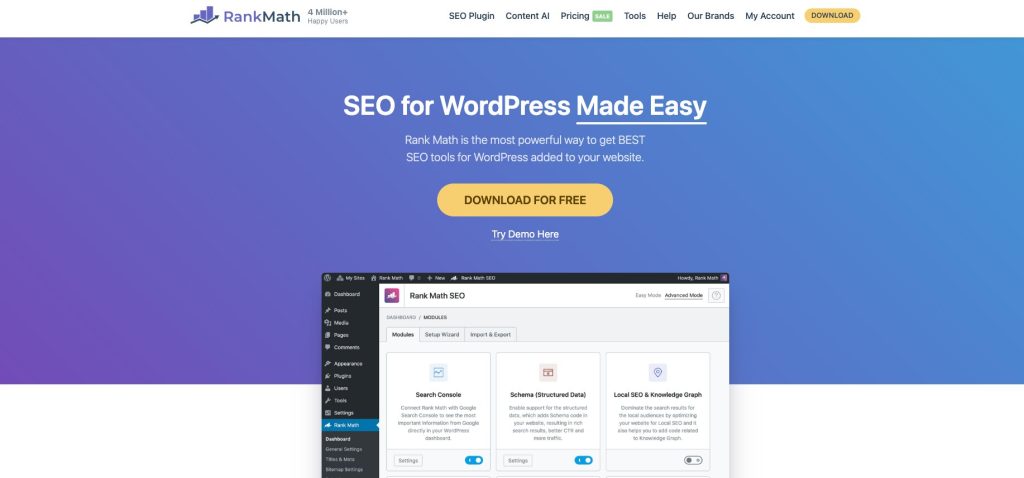
Core Strength: Rank Math is a WordPress SEO plugin with an unusually generous free tier, including unlimited keyword optimization per post, 18 schema types, a redirect manager, and Google Search Console integration, plus a Content AI feature for on-page suggestions.
Pricing: The free tier is genuinely full-featured. Paid tiers cover unlimited personal sites on Pro and multiple client sites on Business or Agency, with reported figures varying by source and by intro versus renewal pricing, roughly Pro at $59 to $100 per year, Business at $199 to $336 per year, and Agency around $780 per year. Exact current pricing is worth confirming directly on rankmath.com.
Best Suited For: Agencies managing multiple WordPress client sites who want broader free-tier schema and local SEO coverage than Yoast offers, or bloggers who want Pro features without per-site pricing.
Pros:
• One Pro license covers unlimited personal sites, unlike Yoast’s per-site model
• Stronger free-tier feature set including built-in local SEO schema
• Lighter codebase
Cons:
• Pricing reporting across sources is inconsistent and needs direct confirmation
• Steeper initial learning curve than Yoast for total beginners
8. NeuronWriter
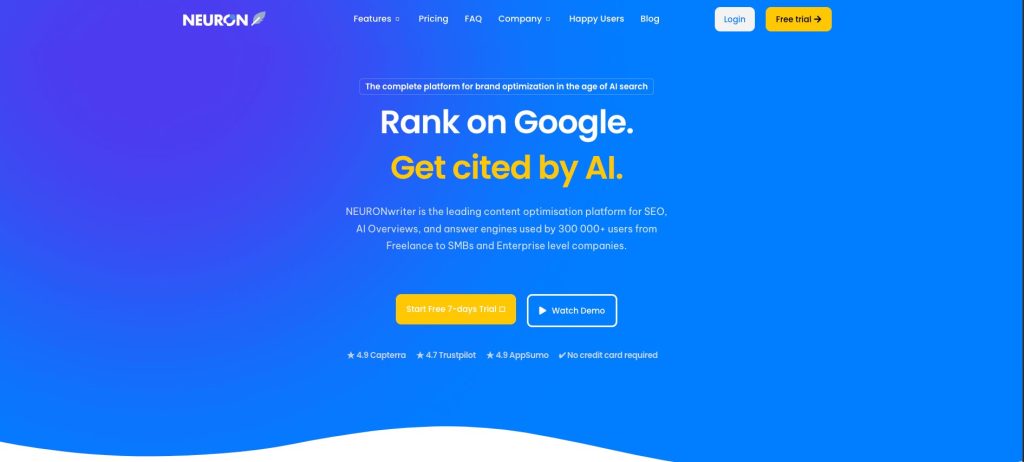
Core Strength: NeuronWriter offers NLP-based content optimization and SERP data positioned as a more affordable alternative to Surfer and Clearscope, with real-time term recommendations pulled from actual ranking pages.
Pricing: Plans start around $23 per month, with a Gold plan offering unlimited users and API access around $69 per month.
Best Suited For: Solo consultants and small agencies that want Surfer-style content scoring without the premium price tag.
Pros:
• Budget-friendly relative to Surfer, Clearscope, and Frase
• Unlimited users even on lower tiers via the Gold plan
• Solid NLP term recommendations
Cons:
• Interface is less polished than premium competitors
• Smaller feature set than the more established platforms
9. PageOptimizer Pro (POP)

Core Strength: PageOptimizer Pro is an on-page optimization tool built on more than 400 independent SEO tests rather than correlation-based guessing, focused specifically on page-level changes.
Pricing: Roughly Basic at $34 to $40 per month for 20 credits, Premium at $47.50 per month for 40 credits, Unlimited at $61 to $72 per month for unlimited reports, and Teams at $120 to $143 per month for 5 sub-accounts. There’s a 7-day refund guarantee and no free trial, and figures vary somewhat by source and date.
Best Suited For: SEOs and site owners who want a lower-priced, science-backed on-page tool focused specifically on page-level fixes.
Pros:
• Unlimited reports on the Unlimited tier beats per-report caps on competitors
• Integrates with MarketMuse for teams using both
• Scientific testing-based methodology rather than pure correlation
Cons:
• Steeper learning curve than more polished competitors
• Narrower scope than all-in-one platforms
• Pricing reporting varies enough across sources to need direct confirmation
10. Detailed SEO Extension
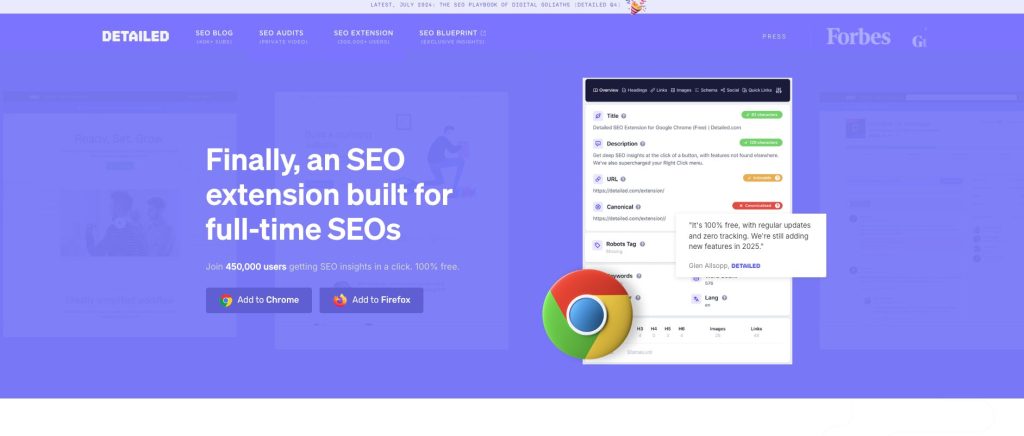
Core Strength: Detailed SEO Extension is a completely free Chrome browser extension, recently acquired by Ahrefs, that instantly surfaces title tags, meta descriptions, canonical URLs, robots directives, heading structure, and schema markup for any page with one click.
Pricing: 100 percent free, with no paid tier and no upsells.
Best Suited For: Writers, marketers, and site owners who want a fast spot-check tool for quick on-page QA rather than a full optimization platform, and a good complement to any of the paid tools above.
Pros:
• Completely free with no functional limitations
• Used by more than 450,000 people weekly with a 4.8 out of 5 rating
• Lightweight, doesn’t slow down the browser
Cons:
• Not a scoring or optimization tool, just a diagnostic snapshot
• No historical tracking or reporting
• Chrome and Chromium only
FAQ
Do AI search optimization tools really work?
Yes, when used to close real content gaps rather than just chase a score. Tools like Surfer, Clearscope, and Frase have measurable track records of improving rankings and AI citations when their suggestions are applied thoughtfully. They work best as a guide, not a replacement for genuine expertise and original insight.
How do AI search optimization tools increase organic traffic?
They close the gap between what your page covers and what the highest-ranking, most-cited pages already cover on a topic. Tools like Surfer, Clearscope, and Frase highlight missing subtopics and terms that top pages consistently include. That completeness is also what makes a page more likely to get cited inside an AI Overview or chatbot response.
Do I need a separate AI optimization tool, or can I just use ChatGPT?
ChatGPT can help you draft and rewrite faster, but it doesn’t analyze what’s actually ranking or score your content against real competitors. The tools on this list are built specifically to close that gap. Pairing ChatGPT with a dedicated optimization tool gets you further than using ChatGPT alone.
The tools on this list help you optimize the content itself, but citations and rankings both still depend on genuine authority signals like backlinks and mentions from sources AI systems trust. That’s the part Yaaply focuses on.