
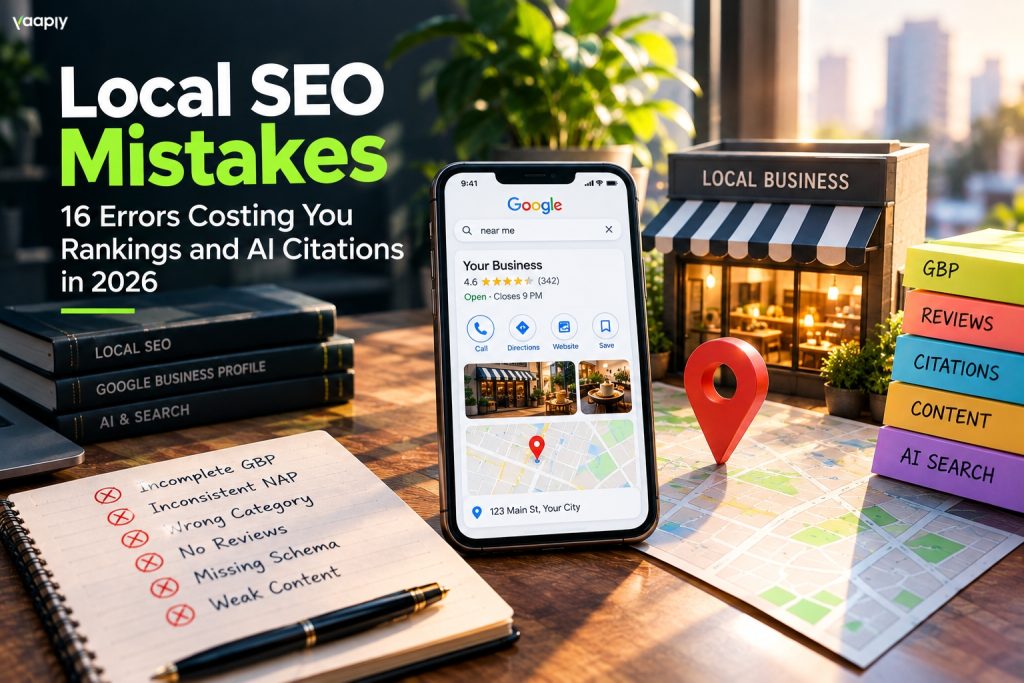
Most local SEO mistakes fall into three buckets: an incomplete Google Business Profile, inconsistent business information across the web, and content that never gets structured for how AI search engines actually read it. Fixing the first two shows results within weeks. The third is where most businesses are still years behind.
Key takeaways
- A weak or incomplete Google Business Profile is still the single most common local SEO mistake, and the one with the fastest fix.
- Backlinks alone are a weak predictor of AI citation. Ahrefs’ 2026 study of 75,000 brands found web mentions correlate with AI Overview visibility 3x more strongly than backlinks (0.664 vs 0.218).
- 76% of AI Overview citations come from pages that already rank in the top 10, so backlinks still matter, just not directly. They get you into the pool AI models cite from.
- Local search behavior has shifted fast. Consumer use of ChatGPT to find local businesses rose sharply between 2025 and 2026.
- Question-shaped content, structured data, and named authorship all correlate more strongly with AI citation in 2026 than they did even a year ago.
Local SEO mistakes at a glance
| Mistake | Impact | Fastest fix |
| Incomplete Google Business Profile | Invisible in 60%+ of local searches that never reach a website | Fill every field, post weekly, respond to every review |
| Wrong or too-broad GBP category | Losing rankings to competitors with a more specific category | Pick the most specific primary category, add secondary ones |
| Inconsistent NAP across directories | Google treats listings as separate, untrustworthy businesses | Standardize name, address, phone everywhere, audit quarterly |
| Weak review strategy | Lower trust score, fewer conversions, weaker AI sentiment signal | Ask every satisfied customer, respond within 48 hours |
| Generic instead of long-tail local keywords | Competing for terms you can’t win, missing how people actually search | Target conversational, neighborhood-specific phrases |
| One generic page instead of city pages | Google can’t match hyper-local intent to a hyper-local page | Build a real page per city or neighborhood served |
| No schema markup | AI systems can’t parse what your business actually is | Add LocalBusiness, Service, and FAQ schema |
| Slow, non-mobile site | Losing the 80%+ of “near me” searches done on mobile | Fix Core Web Vitals, test on an actual phone |
| Treating backlinks as the whole AI citation strategy | Missing the signal that correlates 3x stronger with AI visibility | Pair link building with earned mentions and listicle placements |
| Ignoring AI Overviews and AEO | Content never gets pulled into AI-generated answers | Write question-shaped headings with direct answers underneath |
| No voice search optimization | Missing a growing share of “near me” queries | Write in natural, conversational Q&A language |
| Thin or irregular content | No fresh signal to Google or AI crawlers | Publish on a real cadence, answer real customer questions |
| Unaddressed technical SEO issues | Content and reviews can’t help if pages aren’t indexed | Run a quarterly technical audit via Search Console |
| Missing E-E-A-T signals | Content reads as unverifiable to both Google and AI systems | Named authors, real credentials, real case studies |
| No tracking beyond website traffic | Flying blind on what’s actually working | Track calls, direction requests, and GBP interactions |
| Generic content ignoring vertical nuance (e.g. law firms) | Content doesn’t match how that specific buyer actually searches | Write vertical-specific sections, not swapped keywords |
What is the single biggest local SEO mistake businesses make?
Treating the Google Business Profile as a directory listing instead of a primary marketing channel. Most local searches now end without a single click to a website, which means the GBP itself, not the homepage, is where the buying decision happens for a large share of customers. A profile with a generic description, no recent photos, and unanswered reviews reads as inactive to both customers and to Google’s ranking systems.
Fix it: Complete every field including services, attributes, and the Q&A section. Post updates weekly. Add new photos monthly. Respond to every review within 48 hours.
Why does GBP category selection make or break local rankings?
Your primary Google Business Profile category is one of the strongest local ranking signals available, and it’s also one of the easiest to get wrong. A personal injury lawyer listed under the broad “Law Firm” category is competing against every kind of lawyer for a ranking they’ll rarely win. Google allows up to ten categories total, and most businesses use one.
Fix it: Choose the most specific primary category available, not the closest generic match. Add every relevant secondary category. Review the choice quarterly, since Google adds new categories regularly.
Are inconsistent NAP listings actually a ranking problem?
Yes. Name, address, and phone number inconsistencies across directories are one of the most common and most fixable local SEO mistakes. “123 Main St” on Google, “123 Main Street” on Facebook, and “123 Main St., Suite A” on Yelp reads to a human as a rounding error. Google’s systems read it as three possibly different businesses, which erodes trust in every listing at once.
Fix it: Create one master NAP document with the exact formatting you’ll use everywhere. Audit every major directory (Google, Yelp, Facebook, Apple Maps, Bing Places, industry-specific sites) against it quarterly.
Does a weak review strategy really cost rankings and revenue?
Reviews now do double duty. They’re a trust signal for customers and an active ranking input for Google, and in 2026 AI systems also perform sentiment analysis on review language, not just star counts. A business with fewer, more specific reviews (“fixed our AC in two hours on a Sunday”) can outperform a business with more reviews that all say some version of “great service.”
Fix it: Build a systematic ask process for every satisfied customer. Respond to every review, positive or negative, within 48 hours. Never argue publicly with a negative review; acknowledge it and move the resolution offline.
Is keyword stuffing still a mistake in 2026, or is it something else now?
The mistake isn’t stuffing anymore, it’s genericness. “Plumber Fort Lauderdale” is a start, not a strategy. Real searches, especially voice searches, are longer and more specific: “emergency drain cleaning open on Saturday near me.” Businesses that only optimize for the short, obvious phrase miss the much larger volume of specific, high-intent searches happening around it.
Fix it: Research long-tail, conversational local keywords. Build dedicated service-plus-location pages instead of one page trying to rank for every city you serve.
Do local businesses actually need separate city pages?
If you serve more than one city or neighborhood, yes. A single “we serve the greater [region]” page tells Google nothing specific about any one place, and a searcher in one neighborhood wants a page that clearly speaks to their neighborhood, not a bullet list of fifteen cities at the bottom of a generic page.
Fix it: Build one real page per city or major neighborhood, referencing actual local details (landmarks, common local issues, neighborhood names), not a templated page with the city name swapped in.
Does schema markup actually change local rankings?
It doesn’t directly move rankings the way backlinks or content depth do, but it determines whether AI systems and rich results can understand your business at all. A human visiting your site can infer that you’re a dentist in a specific city. ChatGPT, Perplexity, and Google’s AI Overviews need machine-readable structure to make the same inference reliably.
Fix it: At minimum, implement LocalBusiness schema with NAP, hours, and service area. Add Service schema per offering and FAQPage schema on any FAQ content.
Is mobile speed really a local ranking factor?
Yes, directly. The majority of “near me” searches happen on mobile, and Google evaluates the mobile version of your site for ranking under mobile-first indexing. Core Web Vitals (loading speed, interactivity, visual stability) are direct ranking inputs, not soft usability suggestions.
Fix it: Test with Google PageSpeed Insights. Compress images, minimize JavaScript, and physically test the site on a phone, not just a resized desktop browser.
Why does treating backlinks as your whole AI visibility strategy fall short?
This is the mistake most local SEO advice still gets wrong, including most of what’s published on this exact topic. Backlinks were the entire authority model for two decades, and they still feed Google’s core ranking. But a 2026 Ahrefs correlation study of 75,000 brands found that web mentions correlate with AI Overview visibility roughly three times more strongly than backlinks do (0.664 versus 0.218). Separately, Muck Rack’s 2026 analysis of 25 million links found earned media accounts for the large majority of AI citations, not link volume.
That doesn’t make backlinks worthless. Around 76% of AI Overview citations still come from pages that already rank in the top 10, and strong backlinks are part of what gets a page ranking well enough to enter that pool. The mistake is treating link volume as the finish line instead of one input into a longer trust chain that also includes brand mentions, digital PR placements, and listicle inclusion, the kinds of coverage that AI systems are citing directly.
Fix it: Pair traditional link building with earned brand mentions and digital PR placements. A relevant mention in a well-trafficked listicle or press piece is now doing more for AI visibility than another generic guest post link.
What happens if you ignore AI Overviews and answer engine optimization?
Your content stops getting pulled into the answers that increasingly replace a click altogether. Google’s AI Overviews now appear across a large and growing share of search queries, and when they do appear, they meaningfully reduce clicks to the underlying pages. Answer Engine Optimization means writing so that an AI system, not just a human skimming, can lift a clean answer out of your content.
Fix it: Write real questions as headings, with the direct answer in the sentence immediately after. Skip the scene-setting before the answer. Structure comparisons and specs as tables, not paragraphs.
Do local businesses need to optimize for voice search specifically?
Voice queries are longer, fully conversational, and phrased as complete questions rather than fragments. Someone typing searches “dentist [city].” Someone speaking to an assistant asks “where’s the closest dentist near me that’s open right now.” Most local businesses still write for the typed fragment only.
Fix it: Write FAQ content in natural speech patterns. Use full question headings. Keep hours, services, and location data structured so voice assistants can read them cleanly.
Why does a thin or irregular content strategy quietly kill local rankings?
Publishing a generic post every few months doesn’t build the topical depth Google or AI systems reward, and it gives AI engines nothing worth citing. The businesses winning local visibility right now are answering the actual questions their customers type into Google, not recycling generic industry tips.
Fix it: Build a real content calendar. Pull topics from your own Google Business Profile Q&A, Search Console queries, and “people also ask” boxes. Every piece should link to a relevant service or location page.
Can unaddressed technical SEO issues undo everything else?
Yes. Reviews, content, and backlinks can’t help a page that search engines and AI crawlers can’t properly access. Broken links, missing sitemaps, slow load times, and crawl errors are invisible to most business owners and directly damaging to rankings.
Fix it: Run a technical audit at least quarterly through Google Search Console. Fix broken links, set proper redirects, and confirm every page has a unique title and meta description.
Do E-E-A-T signals matter for a local business, or is that only for big publishers?
They matter more for local businesses now, not less, because E-E-A-T (Experience, Expertise, Authoritativeness, Trustworthiness) is exactly what separates a real local business from a templated or AI-generated competitor page. A generic “Our Team” page with stock photos signals nothing. A named author with real credentials, or a case study with specific project details, signals a lot.
Fix it: Use real author bylines on content, not a generic company name. Publish case studies with real specifics. Link out to credible external sources when citing statistics, the same practice this article follows.
Is tracking website traffic enough to know if local SEO is working?
No. Most local searches now end in a phone call, a direction request, or a Google Business Profile interaction that never touches the website at all. Measuring success by pageviews alone misses the majority of what local SEO is actually delivering.
Fix it: Track phone calls and direction requests through GBP Insights and call tracking, alongside standard analytics. Review local pack positions for your core keywords monthly.
Local SEO mistakes specific to law firms
Law firm local SEO carries mistakes the general list above doesn’t fully capture, because legal search behavior and legal marketing rules are both unusual.
- Practice area category mismatch: listing under a broad “Law Firm” category instead of the specific practice area (Personal Injury Attorney, Family Law Attorney, Criminal Defense Attorney) is one of the single most common and most costly mistakes for law firms specifically, since Google’s local pack ranks by category specificity.
- No jurisdiction-specific content: a firm serving three counties with one generic “practice areas” page misses the searches phrased around a specific court, county, or local statute.
- Weak review volume from a low-frequency client base: law firms see far fewer repeat interactions than a restaurant or plumber, which makes a deliberate, compliant review-ask process (checked against state bar advertising rules) far more important than for most other verticals.
- Directory mismatch: general local directories matter less for law firms than legal-specific ones (Avvo, Justia, FindLaw), and citation consistency across those legal directories carries more weight for this vertical specifically.
Fix it: Build practice-area-specific pages per jurisdiction served, not one generic “our practice areas” page. Prioritize legal-specific directories over general business ones. Build a compliant, systematic review process rather than relying on organic ask volume.
Local SEO Mistakes FAQ
What are the most common mistakes in local SEO?
An incomplete Google Business Profile, inconsistent NAP information across directories, and generic content that ignores city-specific or question-based search intent are the three most common mistakes, in roughly that order of frequency.
What are common mistakes to avoid in local SEO?
Avoid a half-completed GBP, mismatched business information across listings, keyword-stuffed rather than conversational content, missing schema markup, and treating backlinks as a complete AI visibility strategy on their own.
How long does it take to fix local SEO mistakes?
GBP category corrections, NAP fixes, and review responses can show movement within days. Content, schema, and backlink-related fixes typically take 4 to 12 weeks to fully register.
Can I fix local SEO mistakes myself?
The basics, claiming and completing your GBP, fixing NAP inconsistencies, and asking for reviews, are manageable without outside help. Schema implementation, technical SEO, and building a real content and citation strategy for AI visibility usually need dedicated expertise to execute well.
What’s the difference between local SEO and regular SEO?
Local SEO targets the map pack, “near me” searches, and Google Business Profile visibility for a specific location. Regular SEO targets broader, non-location-specific search visibility. Most local businesses with a physical service area need both.