
Top 11 HARO alternatives and journalist outreach tools for digital PR have multiplied since the original HARO went through three ownership changes in under two years. If you’re still bookmarking a dead HARO login page, here’s what’s actually worth using instead.
What happened to HARO, and why there are now two names to know
HARO shut down under its original branding in December 2024, when Cision folded it into a new platform called Connectively. Then in April 2025, Featured.com acquired the HARO brand outright and relaunched it as a free service. Two months later, in June 2025, Featured.com rebranded that revived free service back to the name Connectively. So today, Connectively and Featured.com are two separate products under the same parent company, not competing alternatives to each other.
That matters because you will see both names all over “HARO alternative” lists, and it is easy to assume one replaced the other. It did not. Connectively is the closer spiritual successor to the free, high-volume HARO query flow, though it is not purely free anymore either. It now runs its own Free, Lite, Pro, and Business pricing tiers. Featured.com is the more curated, editorially reviewed paid product built by the same company. Keep that distinction in mind as you read through the list below.
1.Connectively (formerly HARO)

Core Strength: Connectively is the direct successor to the original HARO. It delivers journalist queries to sources and now runs its own four tier pricing structure, verified live on Connectively’s pricing page, making it the platform most people are actually searching for when they type “HARO alternative.”
Pricing: Free ($0/month) includes 3 answers per month, 1 bylined article per month, multiple profiles, and early access to queries. Lite runs $11/month billed yearly and includes 10 answers per month, personalized query matching, 10 daily keyword alerts, and monthly performance reporting. Pro runs $29/month billed yearly and includes unlimited answers, unlimited bylined articles, link type and domain authority filters, PR intelligence, 25 real time keyword alerts, and priority support. Business runs $59/month billed yearly and adds a media database, media list building, AI journalist recommendations, media list exports, premium API access, white labeling, and shared team access. All of those yearly prices are discounted from the higher monthly billed list prices of $19, $49, and $99 respectively, worth noting since the monthly rate looks quite different.
Best Suited For: Businesses and experts who want the classic HARO style query flow, with room to scale from a free plan into paid tiers as their PR needs grow, without switching platforms.
Pros & Cons: The real free tier still exists and name recognition in this category is unmatched, plus the tier progression scales cleanly from a solo expert up to a small PR team needing a media database. The tradeoff is the same one HARO always had at the free level, a high volume of low relevance queries and heavy competition per query since the free plan is open to everyone, and it’s worth remembering that meaningful paid tiers now exist where the product used to be free only.
2. Featured.com
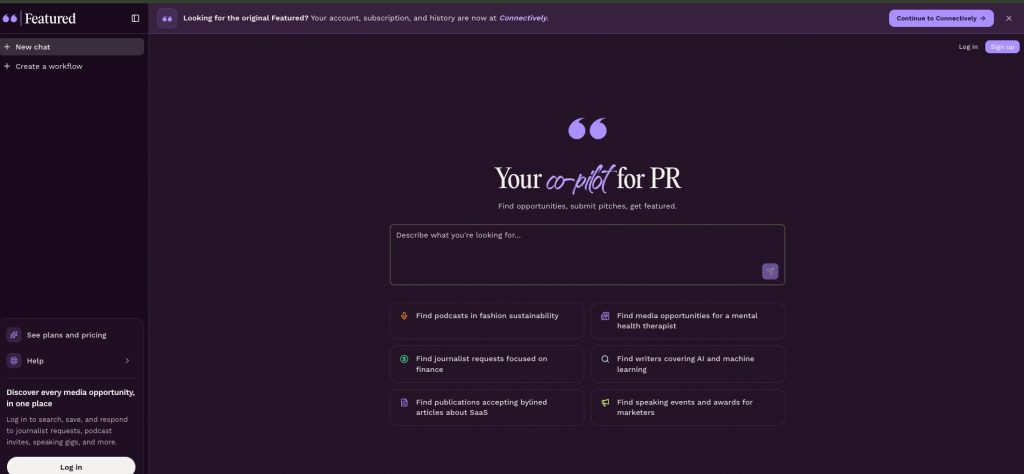
Core Strength: Featured.com is the paid, curated sibling product to Connectively, built by the same parent company. It adds an editorial review layer before your answer goes to a publisher, along with AI answer check tooling to strengthen submissions before they’re sent.
Pricing: A free Starter tier includes 3 answers per month. Paid tiers are seat based and priced per active profile, roughly $29 to $99 per month per seat depending on the plan and whether you pay monthly or annually. Featured’s exact seat pricing has shifted more than once in recent history, so confirm current numbers on Featured’s own pricing page before buying.
Best Suited For: Businesses that want fewer, higher quality placements in outlets like Fortune, Fast Company, and Yahoo, rather than a high volume of lower quality hits.
Pros & Cons: Editorial curation cuts down on AI spam competition, GEO and AI visibility tracking is included even on the free tier, and higher tiers unlock bylined article and interview profile options. On the downside, real volume requires a paid tier, the seat based pricing gets confusing for teams, and there’s no proactive journalist search since you’re only responding to inbound queries.
3. Qwoted
Core Strength: Qwoted matches PR pros and experts with journalists based on expertise profiles, with a strong presence in business and finance trade publications and real time alerts available on paid plans.
Pricing: The Free plan includes 2 pitches per month with a 2 hour response delay. Pro runs $149/month and includes 35 pitches per month, no delay, pitch intelligence, and opportunity research. Team pricing is custom.
Best Suited For: Agencies and in-house teams chasing premium, higher domain rating business and finance publications who are willing to pay for speed.
Pros & Cons: Publication quality is strong, the AI powered pitch intelligence on paid tiers is genuinely useful, and journalist side adoption is active. That said, the free tier is close to unusable given the 2 hour delay and 2 pitch cap, and the Pro plan is the priciest entry point among the query matching tools on this list.
4. Muck Rack
Core Strength: Muck Rack is an all in one PR platform combining a large journalist database, media monitoring, pitching, and reporting. It is not just a query matching feed like most of the others on this list, it functions closer to a full PR CRM.
Pricing: Pricing is not published publicly and is quoted based on annual contracts only. Independently sourced estimates put the entry level around $5,000 per year, mid tier between $10,000 and $15,000 per year, and enterprise between $25,000 and $50,000 or more per year. Treat these as third party estimates rather than confirmed vendor numbers.
Best Suited For: PR agencies and larger in-house comms teams that need a full media database and monitoring suite, not just inbound journalist queries.
Pros & Cons: The journalist database is large and accurate, with over 800,000 podcast contacts alone, reporting and analytics are strong, and the G2 rating sits at 4.6 out of 5 from more than 350 reviews. The downside is that the lack of public pricing makes budgeting difficult, contracts are annual only, and the platform is overkill and expensive for a solo operator or small team that just wants journalist queries.
5. Cision (CisionOne)
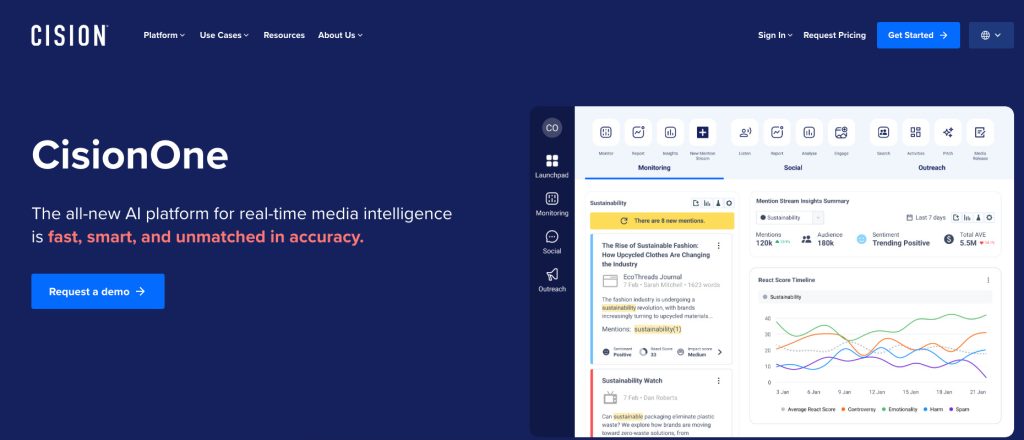
Core Strength: Cision offers an enterprise grade media database and monitoring platform, and it’s the tool most large in-house comms departments already have a login for.
Pricing: Pricing is not published publicly and is enterprise quote based. Independent estimates cite a range of $7,200 to $13,000 or more per year depending on which modules are included.
Best Suited For: Large enterprises and agencies managing multi market PR who need bulk distribution, monitoring, and a massive contact database in one login.
Pros & Cons: The media database and monitoring scale is huge, wire distribution is trusted, and the platform is proven at enterprise scale with over 1,200 G2 reviews at 3.9 out of 5. On the other hand, cost is high relative to a small team’s needs, the UX feels fragmented after years of acquisitions, there’s a steep learning curve, and some contracts require multiple years upfront.
6. Prowly
Core Strength: Prowly, owned by Semrush, is an all in one PR platform covering media database, press release distribution, outreach, and monitoring, positioned as a more affordable and transparently priced alternative to Muck Rack and Cision.
Pricing: The Basic plan runs $369/month, or $258/month billed annually, published openly on Prowly’s site. A 7 day free trial is available.
Best Suited For: Small to mid sized PR teams and agencies who want Muck Rack style features without the opaque enterprise quoting process.
Pros & Cons: Transparent published pricing is genuinely rare in this category, the AI assisted press release writing and journalist Q&A simulation are useful additions, and Semrush’s backing adds stability. The main limitations are a smaller journalist database than Muck Rack or Cision and fewer enterprise scale features.
7. Prezly
Core Strength: Prezly is a PR platform built around branded newsrooms, personalized pitching, and open and click tracking on outreach emails.
Pricing: Plans start at $100/month, published openly, with a 14 day free trial available.
Best Suited For: Teams that want a modern, journalist friendly pitching workflow with visible engagement tracking rather than a query matching feed.
Pros & Cons: The interface is user friendly, the customer support reputation is strong, pricing is transparent, and Prezly holds a 4.3 out of 5 rating on G2. The tradeoffs are a smaller media database than Muck Rack or Cision and fewer advanced analytics features at the entry level price point.
8. SourceBottle
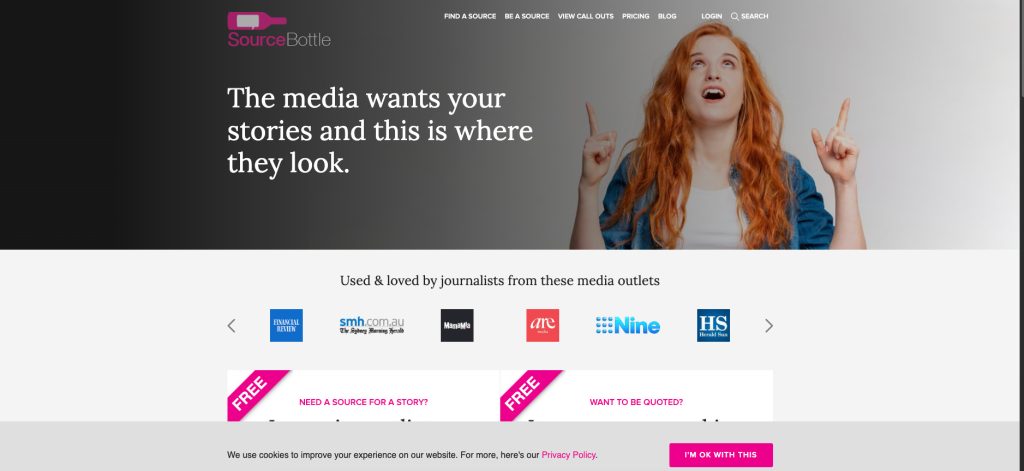
Core Strength: SourceBottle is a free, established journalist and expert matching platform running since 2009, with a strong footprint in lifestyle, travel, parenting, and consumer niches, plus real international reach beyond just the US.
Pricing: A free tier covers basic use. A premium upgrade runs roughly $25 to $65 per month depending on the source, since the exact figure isn’t consistently published, and it adds visibility features along with access to expert posted case studies.
Best Suited For: Consumer, lifestyle, and DTC brands looking for free or low cost media query access outside the strictly business and finance lane.
Pros & Cons: It’s free to start, has a long track record, and offers genuine global reach. The downside is that it skews toward lifestyle and consumer niches over B2B or finance topics, and response speed matters since call outs move fast.
9. JustReachOut
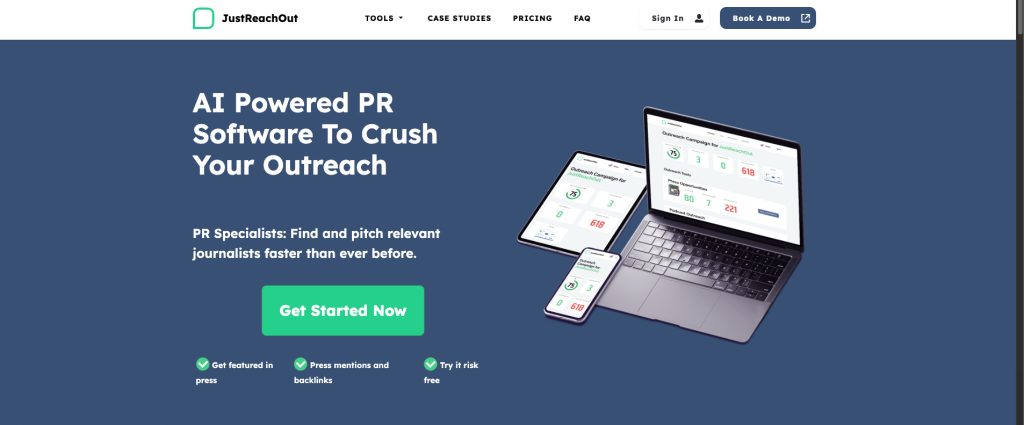
Core Strength: JustReachOut is a DIY PR search and outreach tool built around finding relevant journalists by keyword and sending templated pitches, positioned as a budget alternative to Cision.
Pricing: Reported figures vary meaningfully by source and tier, roughly $65 to $500 per month depending on plan, with G2 listing an entry point around $199/month. Confirm pricing directly on JustReachOut’s site before buying, and note that its G2 review base is thinner than the other tools on this list at 8 reviews and a 4.6 out of 5 rating, real and independently verifiable, just a smaller sample.
Best Suited For: Founders and small in house teams doing DIY PR who want a focused search and pitch tool rather than a full platform.
Pros & Cons: It’s budget friendly relative to Cision and Muck Rack, the contact database is large and manually verified at over 700,000 contacts, and built in outreach templates save setup time. On the downside, pricing is inconsistently reported across sources so it needs direct confirmation, the independent review base is thinner than the rest of this list, and results take 3 to 6 months per the vendor’s own guidance.
10. ResponseSource
Core Strength: ResponseSource is one of the oldest platforms in this category, founded in 1998, and functions as a UK PR industry standard journalist enquiry service with high volume and frequency of requests.
Pricing: Annual subscriptions start at £625 per category, with 25 categories available, and include access to Vuelio’s media database and press release wire.
Best Suited For: Agencies and larger teams that want a long established, high volume enquiry service and don’t mind the UK centric skew of many requests.
Pros & Cons: The volume and frequency of journalist requests is high, the track record spans decades, and the bundled media database and press release wire access add value. The tradeoffs are that pricing scales up quickly with more categories and seats, the platform is more UK weighted than the other tools on this list, and while the journalist side is free, the source and PR side pays per category.
11. PressRanger
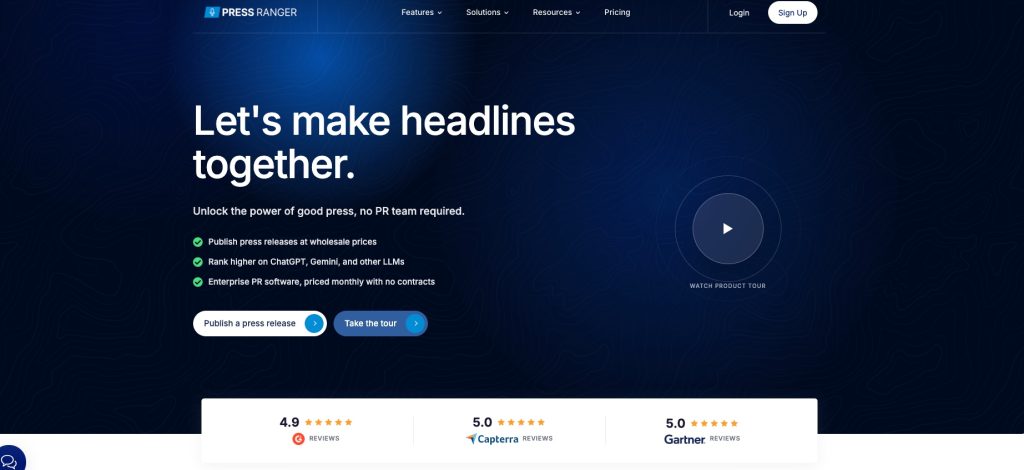
Core Strength: PressRanger combines a database of more than 500,000 journalists, publishers, and podcasts with AI matched outreach, and it specifically aggregates journalist pitch requests from HARO, Connectively, Featured, and X into one dashboard. It’s marketed as HARO without the hassle, and it’s genuinely useful for readers of this exact list since it sits on top of several tools already mentioned here rather than just competing with them.
Pricing: The Free plan includes database access, CRM, and CSV exports, with no AI campaigns. Pro runs $79/month billed annually and includes unlimited AI media campaigns, AI written emails, 5 real time pitch notifications, and wholesale press release distribution access. Pro+ runs $149/month billed annually and covers up to 5 companies, 5 extra seats, and 15 pitch notifications. Press release distribution is priced separately per release, roughly $299 to $399, and is available even on the free plan.
Best Suited For: Startups, small agencies, and solo operators who want one dashboard covering media database search, AI assisted pitching, and HARO style query aggregation instead of juggling several free tools separately.
Pros & Cons: Pricing is unusually transparent for this category, it aggregates multiple other platforms’ pitch requests into one place, and the review base is strong for a newer entrant with more than 60 reviews on G2. On the downside, press release distribution costs stack on top of the subscription per release, some users report occasional outdated contact records in the database, and AI drafted pitches still need manual editing before sending.
Most operators don’t settle on just one of these. Since overlap between platforms is famously low, running two to three at once, typically a free or low cost query tool alongside one paid, curated option, tends to cover more ground than betting everything on a single subscription.
If you’re weighing which combination fits your team’s budget and coverage goals, that’s exactly the kind of digital PR strategy work Yaaply helps clients sort through.